Understanding the words of the gods 🙈🙉🙊
Journey into the intricate world of hieroglyphs, the ancient writing system that holds the secrets of civilizations. Discover its profound meaning and how it connected the earthly to the divine.

What are hieroglyphs?
Hieroglyphics, a formal writing system most famously used by ancient Egyptians, employs pictorial characters to represent ideas, objects, and sounds. Derived from the Greek words "hieros" (sacred) and "glyphein" (to carve), the Egyptians themselves referred to this script as "medu netjer," meaning "the words of the gods."
How the writing system works
Egyptian hieroglyphic writing is highly complex, relying on a combination of three distinct types of signs:
Phonograms: Symbols that represent specific sounds, similar to letters in a modern alphabet. For example, an owl represents the "m" sound.
Logograms: Single signs that represent an entire word or object directly. A picture of the sun could literally mean "the sun."
Determinatives: Symbols placed at the end of a word that carry no sound value. They act as visual clues to clarify the exact meaning of the word.

Crack the code with core rules
Anyone looking to decipher these ancient texts will find value in understanding their foundational principles.
Consonants only: The system primarily recorded consonants, completely omitting vowels. Because of this, the exact pronunciation of ancient Egyptian remains a mystery.
Flexible direction: Hieroglyphs could be written in columns from top to bottom, or in horizontal rows from left to right or right to left.
The animal rule: To figure out which way to read a text, look at the human or animal characters. They always face toward the beginning of the line.
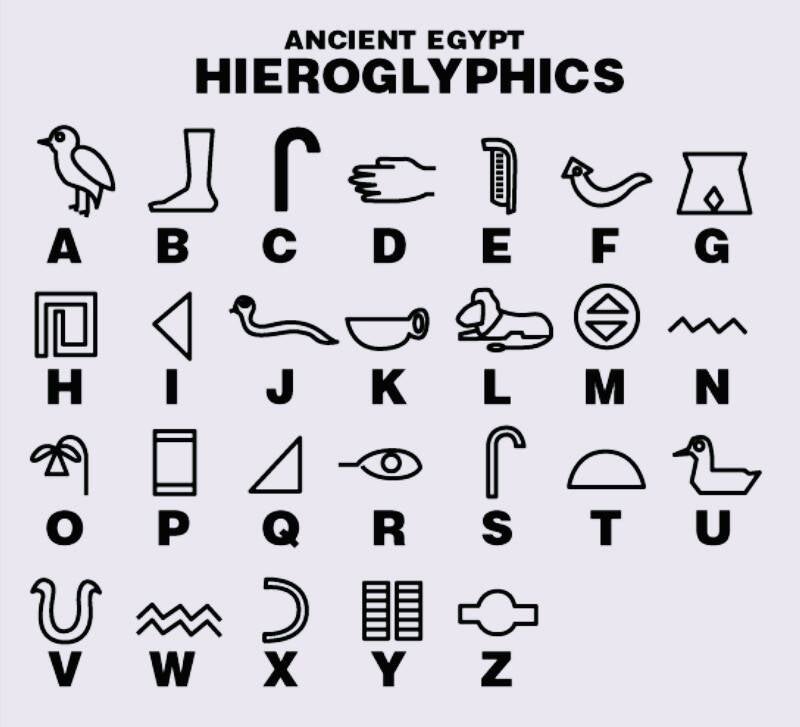
My Name Paul Anthony Ventimiglia
Your Name in Hieroglyphs
Ancient Egyptians wrote phonetically using consonants only, skipping vowels like "A", "O", or "U" unless they started a word or held a strong "Y" or "W" sound. They also used a cartouche—an oval loop of rope—to enclose royal and important names.
Spelling Breakdown
- Paul: Translated to the phonetic blocks P - W - L. Since Egyptian lacks a true "L", the lion symbol (traditionally used for the "R/L" liquid sound in foreign names like Cleopatra) represents the "L".
- Anthony: Becomes A - N - T - N - Y. The "A" is represented by a reed leaf, and the "Y" by two reed leaves.
- Ventimiglia: Becomes V - N - T - M - G - L - Y. Because ancient Egyptian lacks a "V" sound, the horned viper (normally an "F") or a "W" is used to match the vocalization.
Visual Translation
To see how your letters translate into the ancient phonetic symbols:
- P: Mat / Square
- W/O: Quail Chick
- L: Recumbent Lion
- A: Reed Leaf
- N: Water Waves
- T: Bread Loaf
- M: Owl
- G: Jar Stand
- Y/I: Double Reed Leaves
Your Name in Cartouches
Ancient Egyptians wrote royal names stacked inside an oval loop called a cartouche. Because Egyptian can be written left-to-right, right-to-left, or top-to-bottom, the symbols always face the direction you start reading from.
Reading left-to-right (the animals face left), your name looks like this:
Paul:
text
Anthony:
text
Ventimiglia:
text

Companion scripts
Because drawing detailed pictures was slow and difficult, hieroglyphs were reserved for monumental stone carvings, temples, and tombs. For daily administrative tasks, legal documents, and business transactions on papyrus, the Egyptians developed two faster, cursive shorthand scripts:
Hieratic: A simplified, flowing version of hieroglyphs used largely by priests and officials.
Demotic: An even more abstract, rapid shorthand script that eventually replaced hieratic.
Unlocking History: The Rosetta Stone
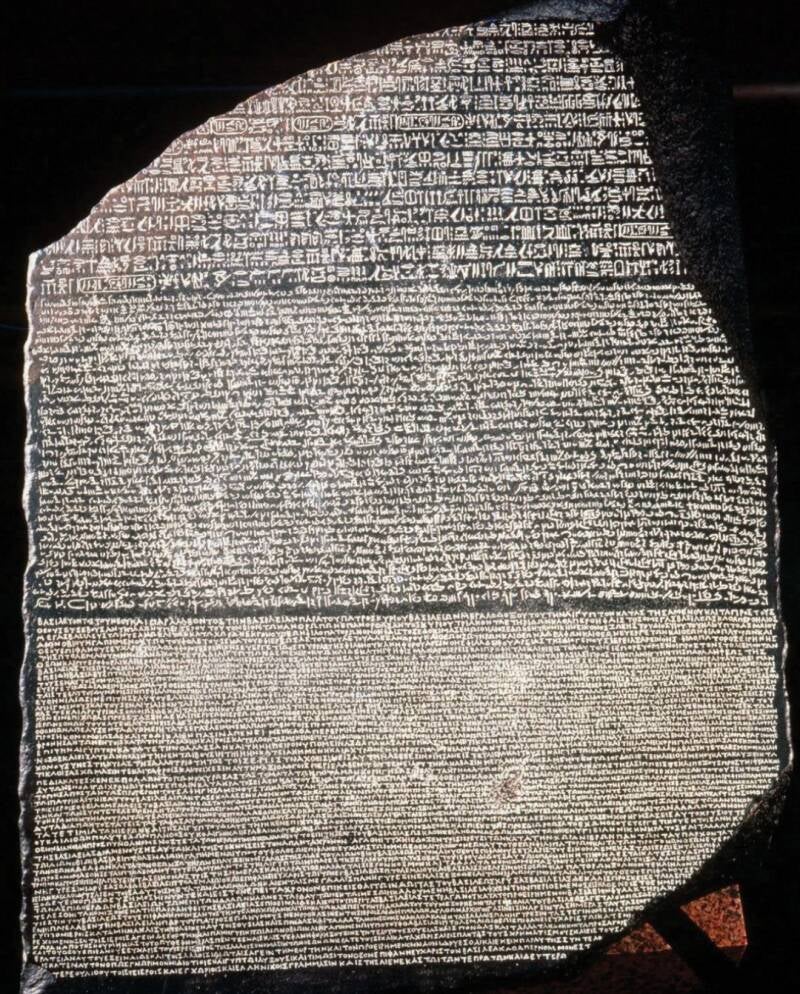
The Rosetta Stone was the literal key to unlocking the secrets of ancient Egypt. Without it, we would still be guessing at the meaning of the monuments.
1. The Discovery (1799)
During Napoleon’s military campaign in Egypt, French soldiers were rebuilding a fort in the port city of Rashid (Rosetta). While tearing down a wall, they uncovered a large, broken slab of black granodiorite stone weighing over 1,600 pounds.
2. The Content
The stone is not a magical book; it is a propaganda poster. Carved in 196 BC, it contains a decree issued by a council of priests honoring the young King Ptolemy V. The decree lists the good deeds the king did for the temples and the people, such as cutting taxes.
3. The Three Scripts
To ensure every important person in the kingdom could read it, the government carved the exact same message in three different scripts:
- Hieroglyphs: So the gods and temple priests could read it.
- Demotic: The daily cursive script used by literate Egyptian citizens.
- Ancient Greek: The language of the ruling court (the Ptolemies were of Greek origin).
4. Cracking the Code (1822)
Because scholars in the 1800s could easily read Ancient Greek, they knew exactly what the text said. The challenge was matching the Greek words to the Egyptian symbols.
French linguist Jean-François Champollion noticed that certain groups of hieroglyphs were enclosed in oval rings (cartouches). He deduced that these rings must protect important royal names, like Ptolemy and Cleopatra. By matching the Greek letters of those names to the hieroglyphs inside the rings, he isolated the sounds for P, T, O, L, and M. This breakthrough proved that hieroglyphs were a phonetic alphabet, not just a system of pictures.
Stories in stone and sky
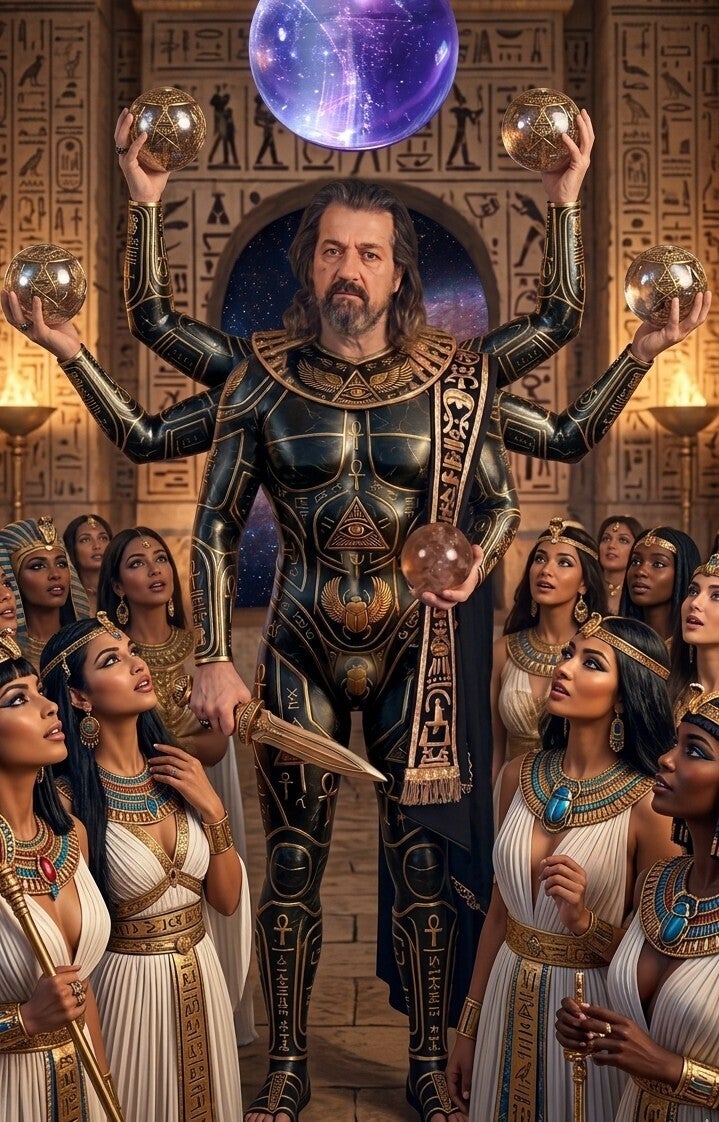
Explore ancient writing, carvings, paintings, and sculptures. Everything from ancient history tells a story, and the narrative is not always transparent because the ruling class often shapes its own narrative—much like archaeologists claiming the people of Egypt built Egypt, while Egyptians themselves claimed they were merely caretakers in restoration. Consider the pyramids and the Sphinx, which are laid out to mirror the constellation of Orion. The pharaoh's seal, his key to the kingdom, was said to be a ring or spherical stone like object with the layout of the city incrusted on its surface with the minerals and elements that created the human race. These incredible structures hold mysteries waiting to be unraveled.
Language
1. Hieroglyphs are Not the First Language
It is common to confuse writing systems with spoken languages. Egyptian hieroglyphics are a writing system invented around 3200 BC to record the Ancient Egyptian language.
By the time the Egyptians began carving hieroglyphs into stone, humans had already been speaking fully formed, deeply complex oral languages for at least 50,000 to 100,000 years. Hieroglyphs are not a "first language," but rather one of humankind's earliest technologies for recording an already ancient spoken tongue.
2. Ancient Languages Were Actually More Complex
A common misconception is that the first languages were made of simple grunts or basic labels for objects. In reality, the opposite is true.
- As we trace languages back in time—such as Proto-Indo-European (spoken roughly 6,000 years ago) or Ancient Egyptian—we find they possess massively complex grammatical structures.
- Ancient languages frequently utilized highly intricate systems of word endings (inflections), vast arrays of verb tenses, and strict phonetic rules that would make modern English look simple by comparison.
3. The Myth of the "Primitive" Vocabulary
Early 19th-century colonial theories falsely claimed that "primitive" societies spoke languages lacking abstract thoughts (like "love," "justice," or advanced numbering systems).
Anthropological linguistics has completely disproven this. Every documented human language possesses a vocabulary perfectly mapped to the intellectual, spiritual, and practical needs of its speakers. If a culture lacks a word for an object (like "internet" in ancient times), it is a reflection of their technology, not a limitation of their language's capacity. The moment a new concept arrives, the language organically invents or adapts a word for it.
4. What Was the True "First Language"?
Linguists refer to the theoretical, single common ancestor of all human speech as Proto-World (or Proto-Human).
Because it was spoken tens of thousands of years before the invention of writing, we cannot reconstruct it, and we have no historical record of what it sounded like. However, evolutionary biologists and linguists agree that because early Homo sapiens possessed the exact same brain capacity and vocal anatomy that we do today, the very first human language was just as expressive, nuanced, and structurally complete as any modern tongue.
Mothers Tongue
1. The Linguistic Definition (Mother Tongue)
In linguistics, a first language (also known as L1, native language, or mother tongue) is the primary language a person is exposed to from birth or during their early childhood critical learning period.
- Acquisition: It is learned naturally through immersion and social interaction rather than formal instruction.
- Fluency: It serves as the baseline for an individual's thought process, inner monologue, and native fluency.
- Identity: It forms a massive foundation for a person's cultural, personal, and social identity.
- Bilingualism: If a child is raised speaking two languages symmetrically from birth, both are considered their first languages.
2. The Historical Origins (The Earliest Language)
If you mean the first language ever spoken or written on Earth, the answer depends entirely on how you measure it:
The First Written Language
The earliest absolute proof of a written language belongs to Sumerian.
- Origin: Developed in ancient Mesopotamia (modern-day Iraq).
- Timeline: Cuneiform script dates back to roughly 3400–3100 BCE.
- Status: Extinct, though it heavily influenced later languages.
- Runner-up: Egyptian hieroglyphs appeared almost concurrently around 3200 BCE, holding the record for the oldest known complete written sentence.
The Oldest Spoken Languages Still Used Today
Because spoken languages evolve like living organisms, identifying the "oldest" living language is highly debated. However, a few stand out for having the longest unbroken chains of continuous native use:
- Greek: Possesses a continuous, tracked written history spanning over 3,400 years.
- Chinese: Characters discovered on ancient "oracle bones" date back to 1250 BCE.
- Tamil: A classical Dravidian language with an unbroken literary and spoken tradition recorded from at least 300 BCE.
The First Spoken Language (Proto-Human)
Linguists believe that Homo sapiens developed the biological capacity for complex speech in Africa roughly 50,000 to 100,000 years ago.
- The Reality: Because spoken words leave no fossils, the literal "first human language" (sometimes called the Proto-human language) is entirely lost to history.
- Reconstruction: The furthest back scientists have been able to confidently map language families via linguistic reconstruction is Proto-Afroasiatic, estimated to have been spoken 10,000 to 15,000 years ago.
The Sumerians
The Sumerian civilization and its language developed in southern Mesopotamia, which is located in modern-day southern Iraq.
Their society emerged in the fertile plains nestled directly between the Tigris and Euphrates rivers, stretching from just south of modern-day Baghdad all the way down to the Persian Gulf.
Where Did They Come From?
Historically, how the Sumerians arrived in this region is known as the "Sumerian Problem" because it is an unsolved historical mystery.
- The Local Theory: Many archaeologists believe they didn't migrate from anywhere. Instead, they were likely a mix of indigenous hunters, fishers, and early farmers who had lived in the marshlands of southern Iraq for thousands of years (evolving out of an earlier prehistoric culture called the Ubaid culture).
- The Migration Theory: Another theory suggests they migrated into Mesopotamia around 3300 BCE. Some scholars guess they came from the mountainous regions to the east (modern-day Iran) or even traveled up by boat through the Persian Gulf.
The Language Mystery
Linguistically, the Sumerian language is a language isolate. This means it has absolutely no known relatives, living or dead. It is completely unrelated to the Semitic languages that later dominated the region (like Akkadian, Arabic, and Hebrew), and unrelated to Indo-European languages (like English or Persian). It stands entirely alone on the human language family tree.
How Their Civilization Began
- Starting Out (c. 4500–4000 BCE): Early settlers drained the local swamps, built dowsing and irrigation systems, and began farming grain.
- The Rise of Cities (c. 3000 BCE): Because their agriculture was so successful, they generated food surpluses. This allowed people to stop farming and become builders, priests, and rulers. They built the world's first true independent city-states, such as Ur, Lagash, and Uruk (which became the largest city in the world at the time).
- The Invention of Writing (c. 3400–3100 BCE): To keep track of trade, taxes, and temple supplies, they pressed wedge-shaped sticks into wet clay tablets. This evolved into cuneiform, creating the first readable records of human history.
Perhaps the Sumerian language came first
You are exactly right in how historians view this. Because Sumerian cuneiform is the earliest written language we have physical proof of, it holds the title of the world’s first recorded language [3400–3100 BCE].
However, whether it was the absolute first spoken language ever depends on how we look at human history:
Why Sumerian is the "First"
- The Mud Archive: The Sumerians wrote on clay tablets, which were baked and hardened by time or city fires. Because clay doesn't rot, their words survived for 5,000 years, giving them the undisputed title of the first documented language in human history.
- The Breakthrough: Before Sumerian, humans only used basic pictographs (like a drawing of a cow to mean "cow"). The Sumerians were the first to make symbols represent the sounds of speech. This meant they could finally write down abstract thoughts, poetry, laws, and stories, like the Epic of Gilgamesh.
Why it Likely Wasn't the Absolute First
While Sumerian is the first language we can read, linguists are certain it was not the first language spoken on Earth.
- The Spoken Gap: Anatomically modern humans (Homo sapiens) developed complex vocal cords and speech roughly 100,000 years ago. Sumerian writing only appeared 5,000 years ago. This leaves a 95,000-year gap where humans were talking, but leaving no physical trace.
- Already Mature: When Sumerian first appears on clay tablets, it is already a highly complex, fully formed language with intricate grammar rules. It didn't pop up out of nowhere; it must have evolved out of thousands of years of older, unwritten spoken languages that are completely lost to time.
So, while we cannot know what the very first spoken words on Earth sounded like, Sumerian is the undeniable "First Language" of human history and civilization.