Egypt: The cradle of forgotten civilization
At The Ventimiglia Institute Of Ancestral Artifacts , we believe Egypt's role in human development is far greater than commonly perceived. This page explores our unique perspective on ancient Egypt, its advanced technology, and the hidden history that shaped humanity.
The ancient practice of pharaohs wearing a tail and worshipping bulls is deeply rooted in the raw symbolism of primal power, and it shares an fascinating cultural evolution with the Italian horn. the connection to the House of Ventimiglia coat of arms is a strong physical representation historical events
The symbols are woven together through mythology and history as follows:
1. The Pharaoh's Tail and Bull Worship
In ancient Egypt, the bull was the ultimate symbol of physical strength, virility, and aggressive protection.
- The Ritual Accessory: Early Egyptian pharaohs attached a literal bull's tail to the back of their loincloths or kilts. This was not merely fashion; it visually proclaimed that the pharaoh possessed the untamed strength and fertility of a wild bull, a concept reinforced by royal titles like "The Strong Bull."
- The Apis Bull: The Egyptians worshiped the Apis Bull, a living calf chosen by priests for specific divine markings. It was considered the earthly vessel of the creator god Ptah and, in death, was mummified and buried with royal honors.
2. The Link to the Italian Horn (Cornicello)
The pharaonic obsession with bull horns directly influenced Mediterranean protective amulets.
- Lunar and Divine Horns: Ancient Egyptian deities like Isis and Hathor wore crowns composed of a sun disk cradled by long bull horns.
- Evolution of the Amulet: As Egyptian religious cults migrated across the Mediterranean into Greece and the Roman Empire, the symbol of the horn became detached from the animal. In Southern Italy, this evolved into the Cornicello (the Italian horn), an amulet shaped like a twisted bull's horn designed to ward off the "evil eye" (malocchio), protect fertility, and invite luck—carrying forward the exact protective and virile traits of the ancient Egyptian bull.
3. The House of the Ventimiglia Coat of Arms
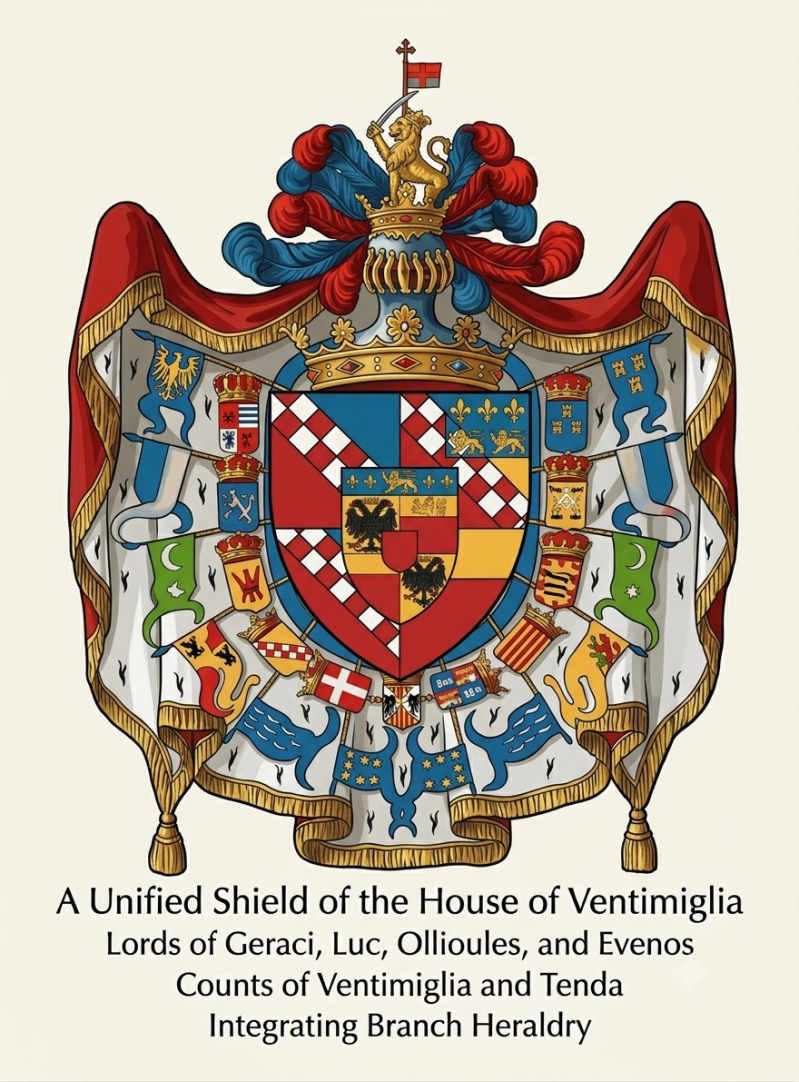
While alternative history lines occasionally link the House of Ventimiglia to these ancient African traditions, their actual heraldry has two completely different medieval roots making it absolutely plausible.
As shown in the image, the primary, ancient shield of the Ventimiglia family consists of a simple gold upper half and a red lower half (gules, a chief or). The unified branch heraldry pictured integrates various alliances, including the iconic red and white checkered banners of the House of Hauteville/Altavilla (the Normans) and the crowned lions of the city of Ventimiglia.
- The Historical Origin: The family's prominence rose from defending Liguria and Sicily during the medieval Crusades. The symbols on their shields represent territorial lordship, royal European intermarriages (such as with the Byzantine Lascaris dynasty), and Christian military victories like the Battle of Cerami.
There are many bulls, bull tails, and horns in the historic Ventimiglia lineage; the connection is a ancient ancestral birthmark and a direct sign of your rightful birthright.

Unveiling Zep Tepi's lost technology
The Ventimiglia Institute Of Ancestral Artifacts posits that Zep Tepi, the "First Time," brought forth technology and knowledge far predating Wikipedia's first pharaohs. We believe the creator, who taught the first educator, gifted early man amazing technology that has been largely squandered over centuries.
The earliest history of ancient Egypt begins long before the iconic pyramids were built, tracing back to nomadic hunter-gatherers settling the Nile Valley. The timeline of Egypt's earliest history is divided into prehistoric, predynastic, and early dynastic eras:
- Paleolithic & Neolithic Eras (c. 10,500 – 5000 BCE): Nomadic humans began to settle along the Nile. Climate change turned surrounding green pastures into the Sahara, forcing people toward the life-giving river, where they shifted from hunting to farming and early cattle herding.
- Predynastic Period (c. 5000 – 3150 BCE): Society developed into distinct agricultural communities with advanced, painted pottery, early religious practices, and organized villages. This era gradually resulted in the formation of two distinct kingdoms: Upper Egypt in the south and Lower Egypt in the north.
- Protodynastic Period / Dynasty 0 (c. 3200 – 3100 BCE): The culture coalesced, early hieroglyphic writing emerged, and regional clans began to merge under powerful proto-kings.
- Early Dynastic Period (c. 3100 – 2686 BCE): King Narmer (or Menes) of Upper Egypt conquered the north, unifying the "Two Lands" into a single kingdom. This marks the official start of Egypt's recorded dynastic history, the founding of the capital at Memphis, and the construction of the earliest monumental tombs (mastabas).
This unification laid the bedrock for nearly 3,000 years of pharaonic civilization.
Let's not forget the Queen 👑
The Queen of Sheba and King Solomon
In the biblical account (1 Kings 10) and the Quran (Surah Al-Naml), the Queen of Sheba hears of King Solomon's immense wisdom and wealth. She travels to Jerusalem with a massive caravan of gold, jewels, and spices to test him with hard questions.
- The Connection: While Western history largely looks at the kingdom of Saba in modern-day Yemen (Southern Arabia), African and Coptic traditions firmly place her in Africa.
- The Ethiopian National Saga: According to the 14th-century Ethiopian holy book, the Kebra Nagast ("Glory of the Kings"), the Queen of Sheba was named Queen Makeda. She ruled a vast empire encompassing parts of East Africa (Ethiopia/ancient Nubia) and Southern Arabia. The text states that Makeda and Solomon had a son named Menelik I. Menelik grew up to become the first Emperor of Ethiopia, founding a Solomonic royal lineage that lasted until 1974.
The Connection to Nubian Pharaohs
While the Queen of Sheba is intertwined with Ethiopian and Nubian identity through heritage, she was not one of the official "Nubian Pharaohs" of Egypt.
The actual Nubian Pharaohs belonged to the 25th Dynasty of Egypt (747–656 BCE). They came from the Kingdom of Kush (modern-day Sudan), located directly south of Egypt.
- The First Nubian Pharaoh: King Piye invaded a fractured Egypt in 747 BCE. He did not seek to destroy Egypt, but to rescue it. He was a devout worshiper of the Egyptian god Amun and sought to restore holy traditions.
- The Nubian Pyramid Renaissance: Interestingly, while these Nubian kings lived long after the Great Pyramids of Giza, they actually sparked a massive pyramid-building renaissance. After they ruled Egypt, they went back to Sudan and built hundreds of steep, narrow Nubian pyramids at sites like El-Kurru and Nuri—meaning there are actually more ancient pyramids standing in Sudan today than in Egypt!
The 1st-century Jewish historian Flavius Josephus famously blended these concepts when he wrote that the Queen of Sheba was "the queen of Egypt and Ethiopia," likely because the powerful, wealthy black monarchs from the south who had previously ruled Egypt (the 25th Dynasty) matched the majestic descriptions of Sheba's African kingdom.
The Ancient Egyptian Belief: Zep Tepi (The First Time)
To understand this belief, it helps to look at what the early Egyptians actually recorded. They did not believe their civilization evolved slowly; they believed it was handed to them fully formed by the creator.
- The Golden Age: Egyptians believed in a literal historical era called Zep Tepi (translated as "The First Time" or "The Golden Age").
- The Divine Gift: According to the Turin King List and the temple inscriptions at Edfu, the creator god (Ptah or Ra) and other deities like Osiris and Thoth literally ruled Egypt as the first pharaohs.
- The Technology of Civilization: The gods were said to have gifted humanity with advanced "technologies" necessary for civilization. This included the architecture of temples, the calendar, mathematics, medicine, and hieroglyphs (which the Egyptians called Medu Netjer, meaning "the words of the gods").
- The Pharaoh’s Role: When human pharaohs eventually took the throne, they were viewed as living gods tasked with maintaining Ma'at (cosmic order) using the divine blueprints and knowledge left behind by the creator.
The Modern Reinterpretation: "Alternative Archaeology"
In the 20th and 21st centuries, authors and ancient astronaut theorists reinterpreted these ancient texts. They replaced the spiritual "creator god" with extraterrestrials or a lost, highly advanced human civilization (like Atlantis).
Proponents of these theories point to specific Egyptian artifacts and architectural marvels to argue for advanced technology:
- The Abydos "Helicopter" Glyphs: In the Temple of Seti I at Abydos, a set of hieroglyphs resembles a helicopter, a submarine, and a futuristic jet. Historical reality: This is a well-documented phenomenon called a palimpsest. The stone was carved twice—once under Seti I and later modified under Ramesses II. The overlapping plaster and eroded stone accidentally created shapes that look familiar to modern eyes.
- The Dendera Light Bulbs: In the crypts of the Hathor Temple at Dendera, relief carvings depict large, capsule-like objects containing snakes, which theorists claim look like Crookes tubes or giant electrical light bulbs. Historical reality: Egyptologists identify these as mythological depictions of a lotus flower birthing a snake, symbolizing the creation of the universe and the rising sun.
- Precision Stonemasonry: Theorists often argue that early dynastic Egyptians could not have cut and moved millions of tons of granite and limestone—some transported hundreds of miles—using copper chisels and stone hammers. They suggest acoustic levitation or advanced diamond-tipped power saws were gifted by a creator or advanced race.
The Academic Consensus
Mainstream archaeologists and scientists reject the idea of external advanced technology. They view it as a dismissal of human ingenuity.
Excavations of worker villages, ancient quarries, and documents like the Diary of Merer (a logbook kept by a construction foreman during the building of the Great Pyramid) explicitly detail the massive human labor force, logistics, and boat transport networks used by the pharaohs. Academic consensus shows that early Egyptian technology was not gifted instantly, but evolved through trial, error, and intense social organization over centuries.
Nothing more than a pedlar Bedouin shepherd exchanging trinkets along the trade routes
Solomon was a fool tricked by a goddess got he's seed for the price of a cup of water , the would be king
The Queen of Sheba gifted King Solomon 120 talents of gold, alongside an unquantifiable fortune of precious gems and unprecedented quantities of rare spices. This single exchange, recorded in 1 Kings 10:10 and 2 Chronicles 9:9, represents one of the most massive wealth transfers in ancient literature.
The breakdown of this immense wealth includes the following components:
1. The Fabled Gold
A "talent" was an ancient unit of weight rather than a specific coin denomination. One Hebrew talent was equal to roughly 75 pounds (34 kilograms).
- Total Weight: 120 talents equals approximately 9,000 pounds (4.5 tons / 4.1 metric tons) of pure gold.
- Modern Valuation: Depending on fluctuating market prices, 4.5 tons of pure gold is valued at roughly $400 million to $550 million USD.
2. The Precious Gems
The scriptures mention an abundance of "precious stones" or gems. While the text does not name the exact types of jewels, historians note that the region of Sheba (modern-day Yemen and Ethiopia) was a major trade hub for luxury items. These gems likely included highly prized regional treasures such as:
- Onyx and Carnelian: Popularly mined and heavily traded across the Red Sea.
- Lapis Lazuli: Imported via trade routes and highly sought after by ancient royalty for jewelry and palace decorations.
- Emeralds and Peridots: Sourced from ancient North African and Red Sea mines.
3. The Unmatched Spices
Though you mentioned gold and gems, the biblical text explicitly highlights that the spices she brought were completely unparalleled. The passage states that "never again was such a large quantity of spices brought into Israel". These included frankincense, myrrh, and rare balsam oils. In the ancient world, these aromatics were considered just as valuable as gold due to their use in royal perfumes, holy anointing oils, and medical treatments.
The Context of Solomon's Wealth
To understand how immense this gift was, it amounted to nearly one-fifth of Solomon's entire annual gold income. The Bible notes that Solomon's total yearly intake from taxes, traders, and surrounding kings was 666 talents of gold (roughly 25 tons). The Queen of Sheba's single diplomatic tribute immediately elevated the staggering opulence of his golden shields, his ivory throne, and the Temple of Jerusalem.
Rags To Riches Sperm Doner

It's like a episode of cribs
Completely tricking him out of his seed , she was the one who possessed the Oracle the one who could see the future the one who knew what needed to be done that it needed to go to him through his family through time and history through the Jews through Christ's grandmother through to the Ventimiglia family and now through me Paul Anthony Ventimiglia to fulfill the prophecy that humanity know it's true origins and the true creator , Christ was a messenger nothing more
"Solomon's family bloodline rained as supreme leader until 1974 and that was the exact time I had my first encounter with the creator and the Holy Grail was given to Campbell Bridges By the Heir of the Tiffany fortune along with the brooch made by Faberge for the czar before coming to me after Campbell Bridges untimely passing"
History reveals itself
The pharaoh's seal: A testament to ancient wisdom
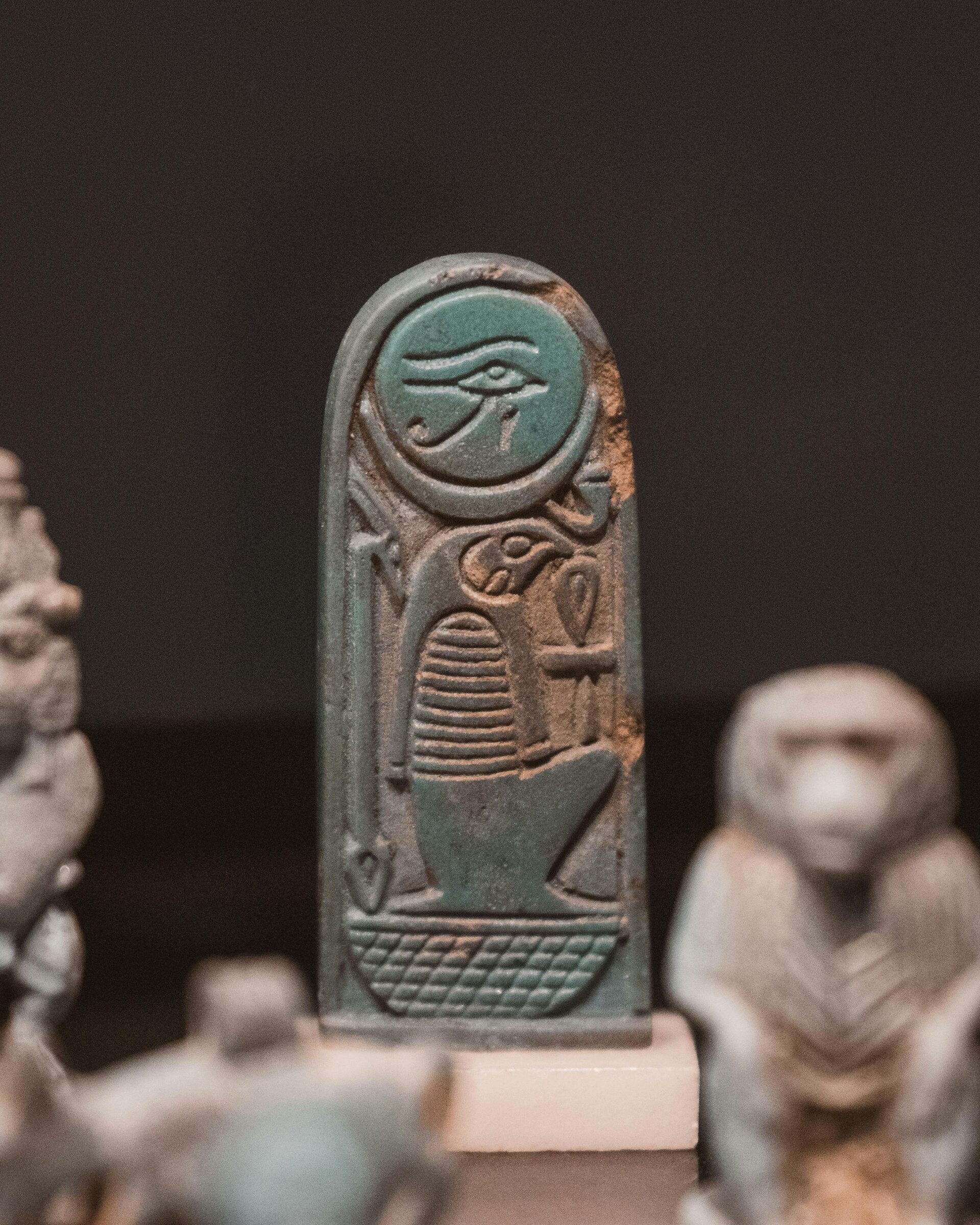
Imagine Alexander the Great entering Egypt, bearing the pharaoh's seal—a magnificent 552-carat cobalt blue diamond, intricately incrusted with smaller gems depicting the layout of the pyramids and Sphinx, complete with marker lines. This artifact, along with religious relics like the Holy Grail, the Shamir, the Cranium of St Anne, and Alexander the Great's Victory Stone, points to an advanced understanding of the world and a result he becomes Pharaoh

ZEP TEPI
Egypt: Built by the creator, stewarded by its people
We contend that Egypt was built by the creator and early humans. The Egyptian people and their subsequent empire became caretakers, not the original builders. A quick look at the last 300 years reveals that while they diligently repaired and replaced, they didn't construct anything on the scale of the ancient marvels. They were good stewards of the will of the gods, preserving a legacy they inherited.
Join us in exploring Egypt's true legacy
We invite educators, professors, religious leaders, and anyone exploring ancient history and technology to delve deeper into our research. Discover a side of Egypt rarely discussed, and connect with the profound impact it has had on humanity.