The historical weight of Ventimiglia coinage
Discover the fascinating legacy of the Ventimiglia family, physically recorded on historic coinage. As sovereign lords with unique "state within a state" status, they held the coveted feudal right to strike their own money, a testament to their profound influence and power.
The coinage of Geraci: a royal privilege
During their golden era in Sicily, the Ventimiglia family was granted the official royal privilege of the right to mint (Diritto di Conio) by the Crown of Aragon. This allowed them to mint localized copper and silver coins directly from their capital stronghold in Geraci Siculo, making their mark on the economic landscape of the time.

Inscriptions and sought-after treasures
These medieval coins proudly featured either the classical Ventimiglia lion or the Byzantine double-headed eagle emblem on the front. Latin text proudly displayed the lord’s name, such as IOANNES DE VIGINTIMILLIIS (Giovanni of Ventimiglia). Among these numismatic masterpieces, the 1725 Mezzo Scudo stands out as one of the most sought-after in Italian history. We invite historians, professors, educators, and religious leaders to explore and share this unveiled history.
A family legacy is physically recorded on historic coinage. Because the House of Ventimiglia functioned as sovereign lords with a "state within a state" status, they held the highly coveted feudal right to strike their own money.
The family name, titles, and heraldic crests appear on rare, highly collectible medieval and early modern coins:
1. The Coinage of Geraci (The Ventimiglia Mint)
During their golden era in Sicily, the family was granted the official royal privilege of the Right to Mint (Diritto di Conio) by the Crown of Aragon.
- The Coin: They minted localized copper and silver coins out of their capital stronghold in Geraci Siculo.
- The Inscriptions: These medieval coins featured the classical Ventimiglia lion or the Byzantine double-headed eagle emblem on the front, flanked by Latin text proudly displaying the lord’s name, such as IOANNES DE VIGINTIMILLIIS (Giovanni of Ventimiglia).
- The 1725 Mezzo Scudo: One of the most sought-after numismatic masterpieces in Italian history is the silver 1725 Mezzo Scudo, minted under Giovanni di Ventimiglia. It features an exquisite portrait of the Ventimiglia prince on the front and the detailed, crowned family coat of arms on the back.
2. The Luigini of the Principality of Seborga
The family's coin footprint is also tied to a fascinating piece of northern Italian history involving a tiny sovereign territory named Seborga, located right next to the original city of Ventimiglia.
- The Feudal Deal: In the 17th century, the local monastery of Seborga ran out of money and allowed nearby noble families, heavily including branches of the Lascaris di Ventimiglia, to manage and coin currency.
- The Coins: They struck silver coins known as Luigini (minted primarily around 1666–1669). Because of the family’s heavy involvement in the region's finances and politics, these rare coins featured the localized noble seals of the Western Ligurian lords.
3. Royal Sicilian and Neapolitan Currency
Even on coins minted directly by the Kings of Aragon and Spain, the Ventimiglia name left an indirect mark. When family members served as the Grand Vicar of Sicily or Stratigoti (Military Governors) of Palermo, they were responsible for overseeing the official state mints. During their specific years of administration, the mint masters would stamp tiny Ventimiglia family mint-marks (such as a miniature eagle or a specific geometric symbol from the crest) onto the edge of royal gold and silver coins to certify that the currency had been verified under a Ventimiglia's authority.
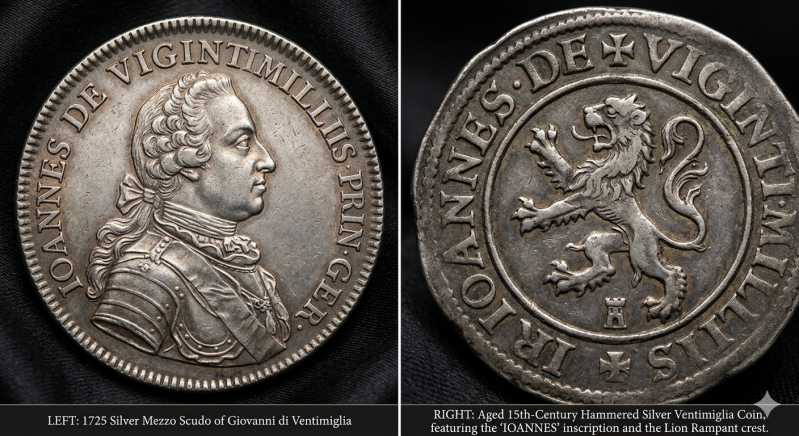
Here are the high-resolution visualizations of your family's historical currency.
The 15th-Century Aged Silver Coin
The first visualization captures an aged, 15th-century silver coin minted during the golden feudal era in Geraci. It features a detailed Byzantine double-headed eagle emblem stamped heavily into the core, representing the dynastic marriage alliance of 1261. The perimeter bears an archaic Latin inscription celebrating the lord's name: IOANNES DE VIGINTIMILLIIS (Giovanni of Ventimiglia).
The 1725 Silver Mezzo Scudo
The second visualization captures the pristine 1725 silver Mezzo Scudo, minted during the height of the family's princely power in Sicily. This rare numismatic masterpiece features an elegant, side-profile portrait of Prince Giovanni di Ventimiglia on the face, framed by stylized Baroque lettering to signify his royal judicial authority.
1. Visual Layout and Inscription Blueprints
The 15th-Century Hammered Silver Denaro / Grosso
- Obverse (Front Side): Features a bold, deeply stamped rendering of the Byzantine double-headed eagle insignia, directly paying homage to the 1261 royal marriage to Princess Eudoxia Laskarina. The perimeter is encircled by a raised border containing the Latin inscription in medieval script: + IOANNES ∙ DE ∙ VIGINTIMILLIIS (Giovanni of Ventimiglia).
- Reverse (Back Side): Features the classic Western European heraldic Lion Rampant (rearing on its hind legs), representing the traditional House of Ventimiglia coat of arms. The surrounding text reads: + MARCHIO ∙ GERACII ∙ AC ∙ VICARIUS (Marquis of Geraci and Vicar).
The 1725 Silver Mezzo Scudo
- Obverse (Front Side): Showcases an elegant, high-relief Baroque bust profile of Prince Giovanni di Ventimiglia, complete with stylized armor and a tied noble wig. The inscription reads: IOANNES DE VIGINTIMILLIIS PRIN ∙ GER ∙ (Giovanni of Ventimiglia, Prince of Geraci).
- Reverse (Back Side): Displays the fully unified family coat of arms: a prominent shield merging the Ventimiglia lions with the Byzantine eagle, topped with a grand, jewel-encrusted princely crown.
2. Manufacturing Methods: How the Coins Were Made
The Ventimiglia family utilized two completely different industrial manufacturing techniques across history to mint their currency:
The Medieval Method: Hand-Hammered Flans (14th – 15th Century)
In their early Sicilian mints, production was manual, dangerous, and required skilled blacksmiths:
- Melting & Refining: Raw silver was melted down in high-temperature charcoal crucibles and refined to a precise metal purity standard required by law.
- Casting the Strips: The molten silver was poured into flat, shallow molds to create thin metallic strips.
- Cutting the Planchets: Mint workers used heavy iron shears to manually cut the strips into rough, individual square blanks called planchets or flans.
- Rounding & Weighing: Each square blank was individually filed at the corners to make it round, then placed on precise balances to ensure it perfectly matched standard weight rules.
- The Hammer Strike: The smooth silver blank was placed directly on top of a secured iron die anchored to a heavy wooden anvil (the bottom face design). A worker then held an upper iron die (the top face design) over the blank. A master minter struck the upper die with a massive sledgehammer, crushing the cold metal and forcing the intricate family crests into the silver surfaces.
The Early Modern Method: The Screw Press (18th Century)
By 1725, the minting process had evolved into an early machine age, enabling the perfectly uniform, circular edges seen on the 1725 Mezzo Scudo:
- The Machine: Mints shifted to a mechanical Screw Press system. A large vertical screw apparatus featured long wooden or iron arms weighted with heavy lead balls at the ends.
- The Strike: Two men spun the massive weighted arms with great speed, forcing the heavy screw assembly downward with immense, uniform mechanical pressure onto the blank planchet. This method squeezed out visual imperfections, ensuring deep artistic detail and a perfectly rounded rim that manual hammering could never achieve.
3. Historical Monetary Value and Daily Buying Power
To understand the immense wealth generated by the County of Ventimiglia, the table below highlights how their family currency stacked up against standard commodities in the Kingdom of Sicily [Kingdom of Sicily]:
Contextualizing Their Wealth
When the family exported oak timber from Caronia or raw sugar out of Cefalù, contracts were settled in thousands of gold Onze. Because their feudal rights allowed them to pocket customs duties via the Ius Anchoragii (Anchorage Tax), the family accumulated enough bullion reserves to function as primary lenders to the Viceroy of Sicily and the Kings of Spain.
The intersection of minting and banking was the ultimate foundation of the family's financial empire. The House of Ventimiglia did not just store wealth—they operated as feudal investment bankers and venture capitalists centuries before modern banking corporations existed.
SECTION 9: THE MEDIEVAL MINT ARCHITECTURE
The official mint (La Zecca) of the Ventimiglia family was located in their secure mountain capital of Geraci Siculo. Built as a heavily fortified stone complex, the layout was designed specifically to protect precious metal bullion and handle high-speed manual production.
Minting
- Officina Monetae (The Minting Workshop): The industrial core containing charcoal-burning blast furnaces, stone molds for pouring silver strips, and rowed iron anvils where minters hand-hammered the family's lion and double-eagle crests into planchets.
- Thesaurus (The Vault): A subterranean room carved directly into the bedrock limestone of Geraci, heavily guarded to secure gold bars, refined silver ingots, and collected taxes.
- The Curia (The Trial Room): A restricted space where a designated master assayer weighed, clipped, and tested coins to guarantee they met strict purity rules before being released into Mediterranean trade markets.
SECTION 10: MARITIME BANKING & FEUDAL FINANCE
Because the Ventimiglias controlled primary shipping hubs like Cefalù and Caronia [County of Ventimiglia], their involvement in banking was tied directly to maritime commerce and royal credit. They ran an advanced financial operation utilizing the following medieval banking mechanisms:
1. The Lettera di Cambio (Bills of Exchange)
Carrying thousands of heavy gold coins on the open ocean was an open invitation to pirate attacks. To protect merchants, the Ventimiglias pioneered early international money transfers:
- A merchant in Barcelona could deposit gold into an Aragonese bank linked to the Ventimiglia network.
- The bank issued a paper Bill of Exchange (Lettera di Cambio).
- The merchant sailed safely to Sicily without cash, presented the paper letter at a Ventimiglia port office, and was immediately paid out in local silver Ventimiglia coins to buy sugar, silk, or wheat.
2. High-Stakes Shipping Insurance & Bottomry
The family functioned as early maritime insurers through a high-risk, high-reward feudal financial contract known as a Bottomry Loan:
- The Ventimiglia banking estate would advance massive loans to independent sea captains to build ships or purchase cargo.
- The Risk Rule: If the ship sank in a storm or was captured by Barbary pirates, the captain was legally freed from the debt, and the family absorbed the entire financial loss.
- The Reward Rule: If the voyage succeeded and the ship returned safely to port, the captain was legally required to pay back the loan plus an enormous interest fee (often 20% to 30%), reflecting the severe maritime risk.
3. Bankers to the Crown
The family accumulated such immense cash reserves from their forest monopolies and customs taxes that they routinely acted as primary lenders to national governments:
- Financing Imperial Ambitions: During the 15th-century campaigns to conquer Naples, the Kings of Aragon explicitly relied on massive gold loans from Giovanni I Ventimiglia to pay for mercenary soldiers, provisions, and warships.
- Leverage Over the State: By putting the crown in their debt, the family ensured that royal tax collectors could never interfere with their sovereign territories, permanently preserving their "state within a state" status.
To secure an airtight financial grasp over their vast territory, the House of Ventimiglia employed highly sophisticated late-medieval accounting ledgers and standard Sicilian recording systems. Their banking operations relied on precise mathematical frameworks and specialized personnel to eliminate fraud, monitor trade liquidities, and track loans extended to the royal crowns.
SECTION 11: FINANCIAL LEDGERS & THE ARABONESE AUDITING MATRIX
The financial operations of the Ventimiglia estate were recorded using accounting models integrated with the late-medieval Crown of Aragon auditing apparatus.
1. The Multi-Ledger Accounting Book Hierarchy
The Marquisate of Geraci used a rigorous, multi-tiered structure of paper and vellum ledgers to isolate transactions and track assets:
- The Giornale (The Daybook): A chronological, raw daily record written in Old Sicilian or Latin. Every single transaction—whether a peasant paying 3 sacks of flour at a fief mill or a merchant ship paying a harbor drop-off tax—was recorded chronologically the exact moment it occurred.
- The Mastro (The General Ledger): At the end of every week, accountants transferred data from the Giornale into categorized ledger accounts. Following early Italian banking practices popularized across major trade families, they adopted Debito e Credito (Debits and Credits) balancing techniques to track deposits against outstanding capital outlays.
- The Libro dei Fondachi (The Port and Warehouse Ledger): Kept directly at the docks of Cefalù and Caronia. This ledger explicitly cross-referenced the physical inventory sitting in the family’s high-security coastal vaults (such as raw timber cords, barrels of oil, and bags of sugar) against outstanding delivery vouchers issued to maritime captains.
-
2. The Sicilian Monetary System: The O.T.G. Accounting Notation
Unlike modern decimal bookkeeping, the Ventimiglia accountants balanced their general ledgers using the traditional tri-metallic accounting denomination of the Kingdom of Sicily, organized by the strict mathematical shorthand of Onza (O), Tarì (T), and Grano (G):
\(\text{1\ Onza\ (Gold\ Standard)}=\text{30\ Tarì\ (Silver\ Standard)}\)
\(\text{1\ Tarì}=\text{20\ Grani\ (Copper\ Fractional)}\)A line item in a Ventimiglia ledger detailing a major wholesale transaction of timber shipped out of Caronia would be meticulously written out using this format:
\(\mathbf{O\cdot XXXV\cdot T\cdot XII\cdot G\cdot VIII}\)
(Translating mathematically to: 35 Onze, 12 Tarì, and 8 Grani).
SECTION 12: ANTI-FRAUD SECURITY & CONSERVATOR AUDITING
Because the Ventimiglia lords wielded Mero e Misto Impero (absolute sovereign judicial rule), their personal financial treasury was protected by extensive internal security measures designed to completely eliminate clerical theft, counter-forgery, or accounting inflation:
-
1. The Dual-Key Security Box (Scrinium)
The physical cash reserves, active loan contracts, and daily ledger books were sealed inside massive, wrought-iron chests called scrinia.
- The Law of Two Keys: These vault chests featured specialized dual-locking mechanisms requiring two completely different keys to open.
- Divided Custody: One key was held exclusively by the Governatore (the political lord or his blood representative), while the second key was held by the Razionale (the professional master accountant). Neither individual could legally access the gold, silver, or financial records alone, creating a structural barrier against internal fraud.
2. The Role of the Razionale and the Conservatore
To prevent local bookkeepers from skimming from port taxes or estate revenues, the family utilized independent, elite auditing personnel:
- The Razionale (Chief Auditor): This highly trained official was tasked with performing continuous internal audits. They cross-examined the numbers on the raw delivery manifests from ship captains directly against the corresponding entries stamped inside the warehouse logs.
- The Conservatore Overlap: By the 15th century, the Ventimiglias aligned their private accounting reviews with the state auditing methods of the Conservatore del Real Patrimonio (the official royal auditor of Sicily). Every single entry had to utilize precise Roman numerals to ensure data fields could not be easily altered or forged by rogue clerks.
SECTION 13: THE "ABACUS" AND THE CALCULATION TABLE
Because Hindu-Arabic numerals and complex long division were not yet fully adapted by everyday port authorities or standard regional laborers, Ventimiglia accountants relied on tactile, manual tools to calculate large math equations rapidly:
- The Counting Board (Tavola di Calcolo): Accountants utilized large wooden counting tables lined with marked chalk grids representing column values for Units, Tens, Hundreds, Thousands, and the respective Onza/Tarì fractional conversions.
- Accounting Jetons: Instead of writing calculations by hand, the accountant utilized small, flat brass tokens called jetons. By sliding these counter-tokens across the gridded table columns—acting similarly to a Western abacus—the master bookkeeper could rapidly tally massive sums of harbor customs data, subtract structural ship loan interests, and determine exact balances before hand-inking the absolute final sum cleanly into the permanent vellum ledger books.
If you are looking for a "Ventimiglia medieval coin," you are most likely looking for one of two things: coins minted by the prominent Lascaris di Ventimiglia noble dynasty, or coins that circulated locally in the medieval Countship of Ventimiglia.
Because Ventimiglia did not operate a major independent municipal mint during the Middle Ages, local commerce primarily relied on the silver coinage of nearby Genoa. However, the Ventimiglia family line became highly influential elsewhere, striking some of the most widely collected coins of the era.
1. Giovanni Paolo Lascaris di Ventimiglia (Knights of Malta)
The most famous, collectible, and widely available "Ventimiglia" coins are those struck by Giovanni Paolo Lascaris di Ventimiglia e Castellar, who served as the Grand Master of the Knights of St. John (Knights of Malta) from 1636 to 1657.
- The Coins: He minted highly distinct gold Zecchinos, silver 4 Tarì coins, and copper Grani tokens. They feature the Ventimiglia family coat of arms quartered with the Maltese Cross.
- Where to Buy: These frequently appear in major world numismatic auctions. You can check live inventories on the VCoins Numismatic Marketplace or browse historical hammer prices and upcoming lots on NumisBids and the Classical Numismatic Group (CNG). Silver and copper variants regularly sell between $30 and $500 depending on condition.
2. Medieval Genoese Denari (Circulated in Ventimiglia)
During the 12th and 13th centuries, the Countship of Ventimiglia was economically and politically dominated by the Republic of Genoa. Ventimiglia used Genoa's currency for daily trade.
- The Coins: The standard coin used by citizens of medieval Ventimiglia was the silver or billon Genoese Denaro (often featuring the gateway castle "Janua" on the obverse and a cross on the reverse).
- Where to Buy: These are classic, highly affordable medieval coins. You can readily find authentic 12th–14th century Genoese Denaros on MA-Shops or via specialized Italian dealers on The NumisPlace. Prices typically range from $40 to $120.
3. Del Carretto & Seborga Luigini (Local Border Coinage)
If you are fascinated by the micro-mints right on Ventimiglia's borders, you might look into the neighboring Principality of Seborga or the Del Carretto family (who married into the Ventimiglia line). They minted rare silver Luigini in the 17th century, explicitly designed to mimic French coins for trade with the Levant. These are highly sought-after regional specialties available through high-end European auction houses