Charlemagne: Father of Europe
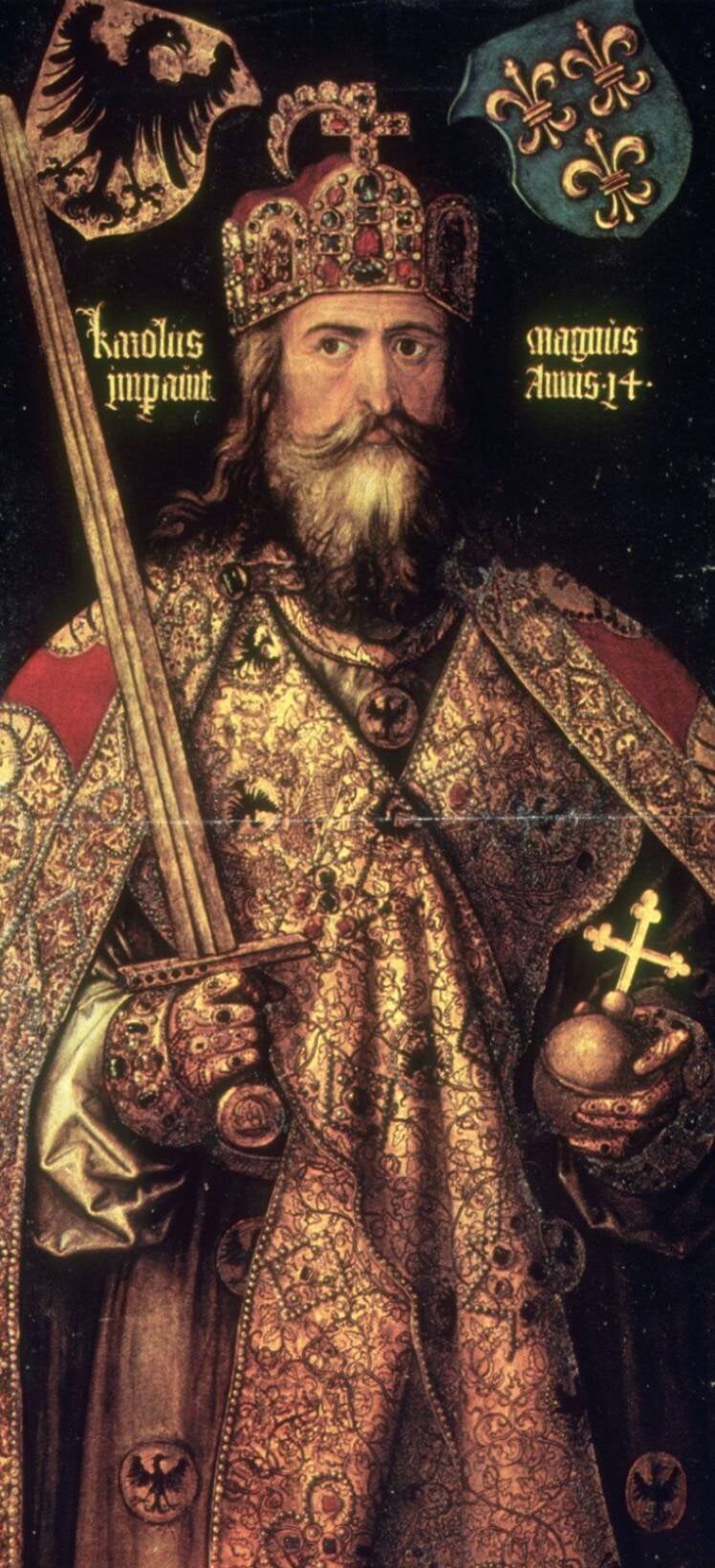
Explore the life and enduring legacy of Charlemagne, the medieval monarch who unified a continent and shaped the future of Europe. Discover his powerful reign, his profound impact, and his surprising connections to ancient lineages.
Charlemagne (Charles the Great) was a medieval monarch who ruled as King of the Franks from 768, King of the Lombards from 774, and was crowned the first Holy Roman Emperor in 800. Often called the "Father of Europe," he united most of Western and Central Europe for the first time since the collapse of the Western Roman Empire. His 46-year reign fundamentally shaped the political, cultural, and religious landscape of the European Middle Ages.
Military Conquests & Expansion
Charlemagne was a highly aggressive military strategist who spent the majority of his reign at war to expand his Christian empire.
- The Saxon Wars: A brutal, 30-year campaign (772–804) to conquer and forcibly convert the pagan Saxons of modern Germany. He famously ordered the execution of 4,500 Saxons at the Massacre of Verden.
- Kingdom of the Lombards: He invaded northern Italy to defend Pope Adrian I, defeating the Lombards and claiming their crown for himself.
- Spanish March: While his initial push into Spain resulted in a famous ambush at the Battle of Roncevaux Pass—immortalized in the epic poem The Song of Roland—he eventually secured a buffer zone against Muslim forces.
Imperial Coronation
On Christmas Day in the year 800, Pope Leo III crowned Charlemagne "Emperor of the Romans" at St. Peter's Basilica in Rome.
- Papal Alliance: The coronation rewarded Charlemagne for protecting the Pope from Roman rebels.
- Political Impact: It revived the concept of the Western Roman Empire and firmly tied European political legitimacy to the Catholic Church.
The Carolingian Renaissance
Charlemagne recognized that running a massive empire required an educated administrative and religious class. He sponsored a cultural revival centered at his capital in Aachen.
- Educational Reforms: He recruited top European minds, such as the English scholar Alcuin of York, to run his palace school and establish libraries.
- Standardized Script: His scholars developed Carolingian minuscule, a clear, uniform style of handwriting that introduced lowercase letters and punctuation, forming the basis for modern printed alphabets.
- Administrative Standardization: He instituted standardized weights, measurements, and a unified silver monetary system to stimulate European trade.
Death and Legacy
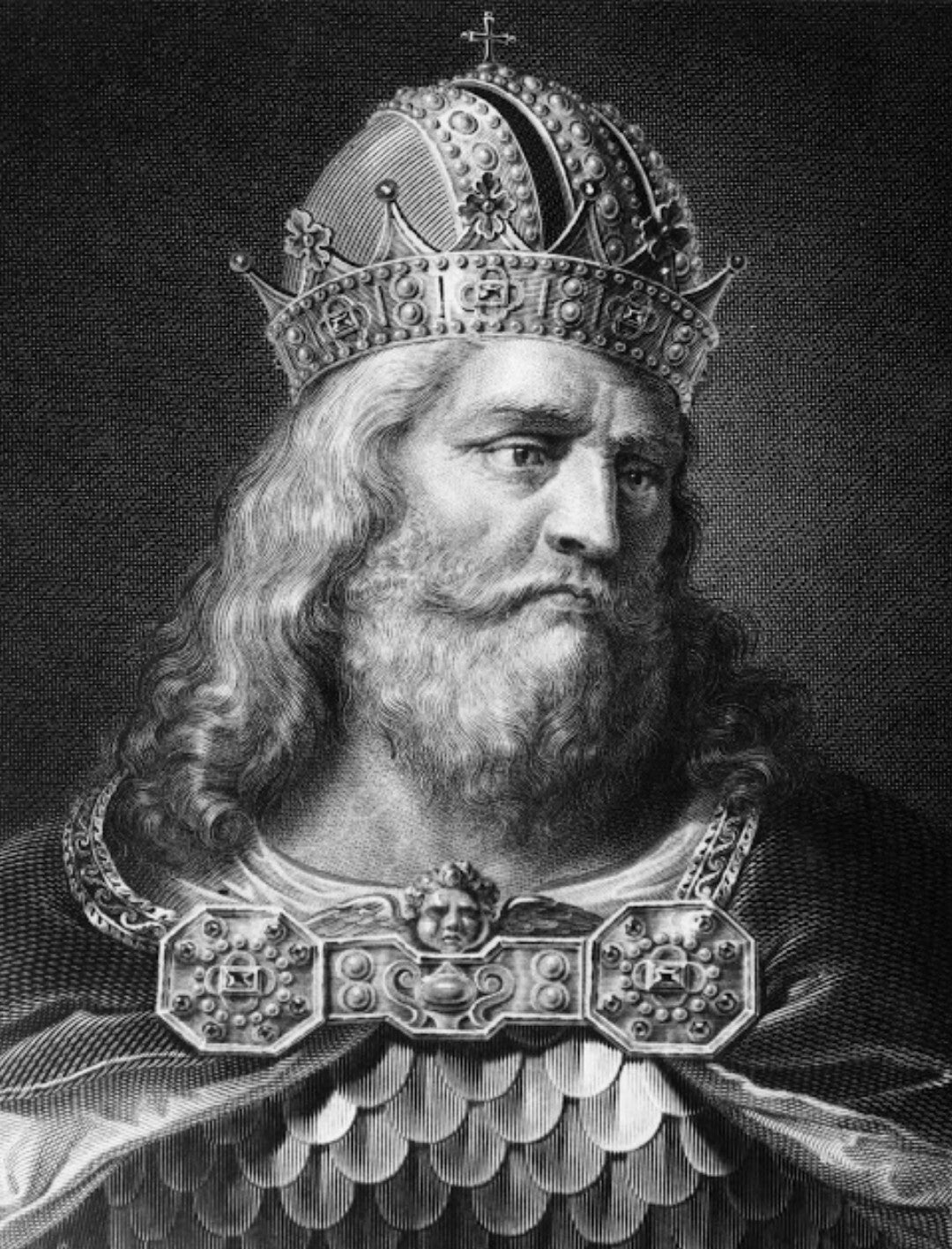
Charlemagne died in 814 and was buried in the Aachen Cathedral. His empire did not outlive his immediate descendants; it fractured under his grandsons via the Treaty of Verdun in 843. This division effectively split the land into West Francia (which became France) and East Francia (which evolved into Germany).
The monarch who shaped a continent
Charlemagne, known as Charles the Great, ruled as King of the Franks from 768, King of the Lombards from 774, and Emperor of the Carolingian Empire from 800 until his death in 814. He is often celebrated as the "Father of Europe" for uniting the majority of Western and Central Europe for the first time since the fall of the Western Roman Empire. His reign, marked by military conquest, administrative reforms, and religious fervor, established the political and cultural groundwork for modern France, Germany, and the broader European continent.
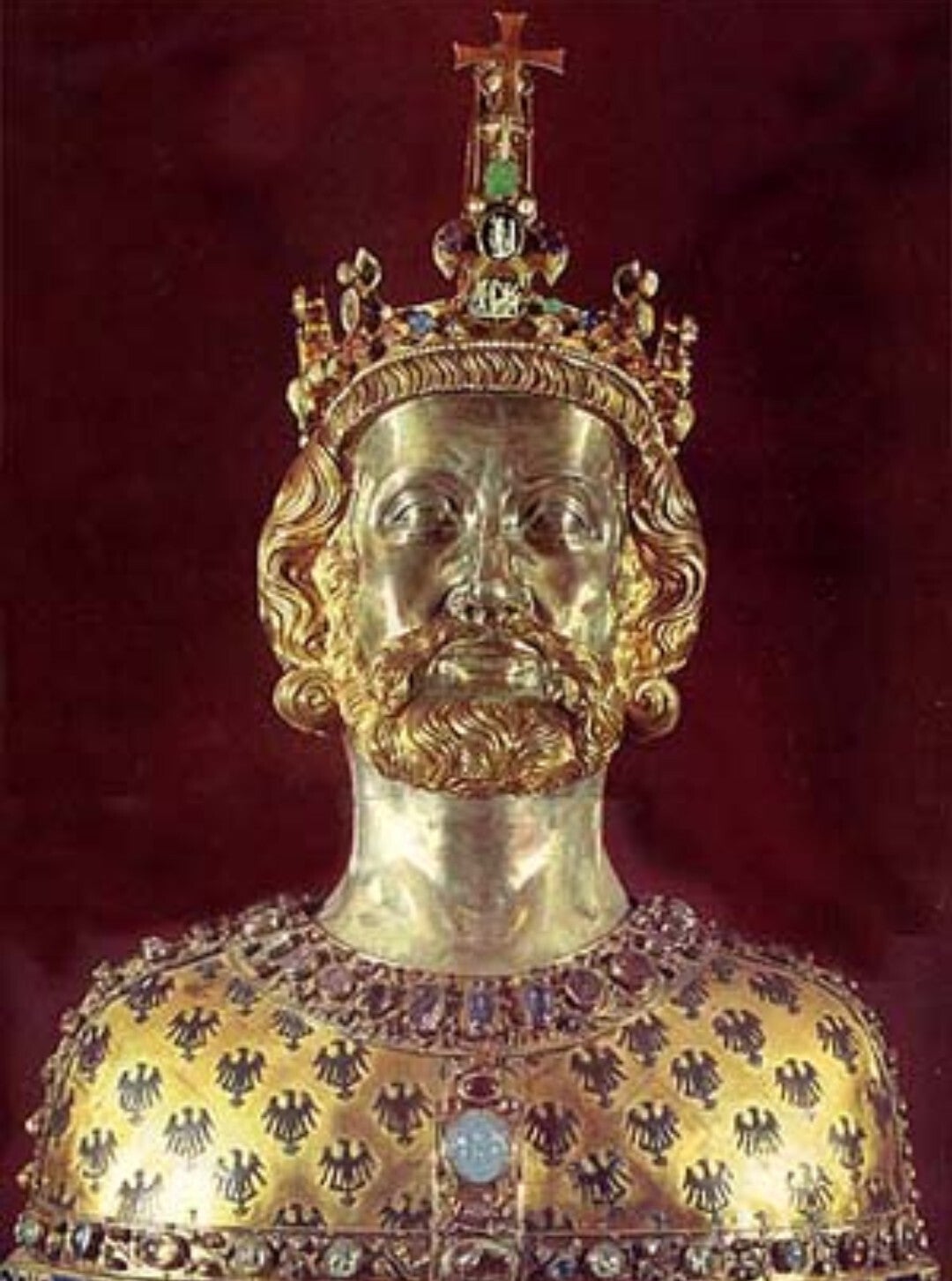
The Bust of Charlemagne (Karlsbüste) is a breathtaking, 14th-century late-Gothic reliquary that houses the actual skullcap (the top part of the skull) of Charlemagne. Kept in the Aachen Cathedral Treasury in Germany, it is widely considered one of the greatest masterpieces of medieval sacral art and Gothic goldwork.
Key Facts About the Bust
- Commissioned by an Emperor: It was donated around 1349–1350 by Holy Roman Emperor Charles IV. He commissioned it to secure his own political legitimacy by tying his lineage back to Charlemagne.
- Materials: The bust is primarily sculpted from chased silver and gold layers. The face features silver-gilt skin, while the hair and beard are covered in detailed gold sheeting.
- Jewels and Imperial Details: The bust is heavily encrusted with antique gems, pearls, and rare carved cameos. The king’s tunic is decorated with the silver Reichsadler (the imperial eagle of the Holy Roman Empire) and the French fleur-de-lis, representing the dual heritage of his empire.
- A Fashion Anachronism: The bust was created more than 500 years after Charlemagne’s death (814 AD). Rather than depicting what he actually looked like, the facial structure, beard trim, and fleur-de-lys crown reflect the idealized high fashion of 14th-century European royalty.
Historical & Liturgical Use
During medieval coronations, the golden bust was carried out and placed in front of the newly crowned Roman-German king to formally affirm him as the rightful successor to Charlemagne's legacy. The octagonal pedestal on which the bust sits features small slots designed for a wooden carrying frame, allowing it to be lifted and paraded during grand religious and political processions.
Scientific Authentication
In 1988, scientists secretly exhumed the bones inside the Aachen reliquaries—including the skull fragments inside this very bust. After years of meticulous forensic testing, researchers concluded that the remains are highly likely authentic, matching the age, robust physical frame, and time period of the legendary historical emperor
Ventimiglia and the Carolingian lineage
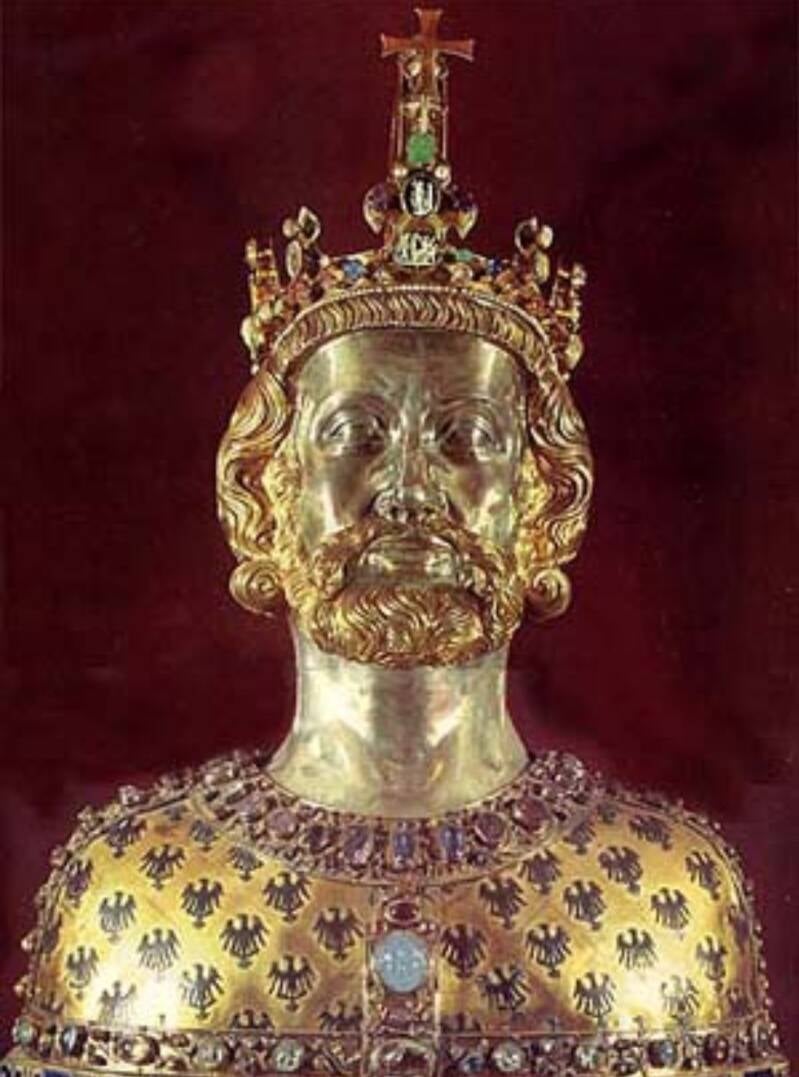
A fascinating aspect of Charlemagne's history is the direct connection between his house and the noble House of Ventimiglia. Through strategic marriages, the destinies of these powerful families became intertwined, shaping the history of Sicily and beyond. These alliances highlight the intricate web of European royalty and the enduring influence of such historical figures on subsequent generations.
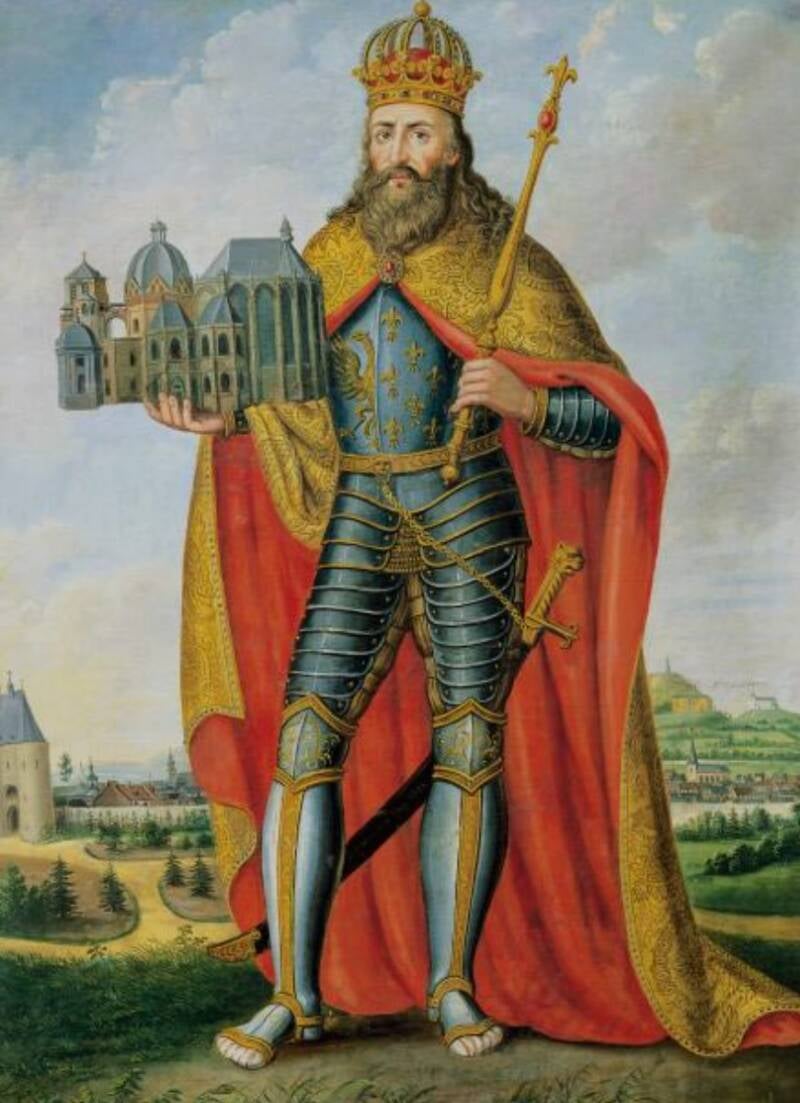
Charlemagne (Charles the Great) was a medieval monarch who ruled as King of the Franks from 768, King of the Lombards from 774, and Emperor of the Carolingian Empire from 800 until his death in 814. Often hailed as the "Father of Europe," he united the majority of Western and Central Europe for the first time since the collapse of the Western Roman Empire three centuries prior. Through military conquest, administrative reform, and religious zeal, his reign laid the political and cultural foundations for modern France, Germany, and the broader European continent.
Military Conquests & Expansion
Charlemagne spent the vast majority of his 46-year reign engaged in almost constant warfare to expand his borders and spread Christianity:
- The Saxon Wars (772–804): A brutal, three-decade campaign against the pagan Saxons in modern Germany. Charlemagne famously ordered the execution of 4,500 prisoners at the Massacre of Verden and forced the surviving population to convert to Christianity under pain of death.
- Kingdom of the Lombards: He successfully defended the papacy against the Lombards in northern Italy, absorbing their territory and styling himself King of the Lombards.
- The Spanish March: His attempts to conquer Muslim Spain met with mixed success. His retreat in 778 resulted in a famous ambush at the Battle of Roncevaux Pass, killing his commander Roland—an event immortalized in Europe's first major epic poem, The Song of Roland.
Imperial Coronation (800 AD)
On Christmas Day in 800 AD, Pope Leo III crowned Charlemagne as "Emperor of the Romans" at Old St. Peter's Basilica in Rome.
- This move revived the concept of the Western Empire and validated Charlemagne's massive territorial footprint.
- It formalized a critical political alliance between the secular Germanic monarchy and the Catholic Church.
- It triggered diplomatic tensions with the Eastern Roman (Byzantine) Empire in Constantinople, which viewed itself as the sole legitimate Roman successor.
The Carolingian Renaissance
Charlemagne launched a major cultural and intellectual revival across his territories, aiming to establish an educated, orderly Christian society:
- Educational Reforms: He gathered the continent's finest scholars—most notably the English cleric Alcuin of York—to run his palace school at Aachen. He ordered monasteries and cathedrals to establish schools open to both elites and peasants.
- Standardized Writing: His scribes developed Carolingian minuscule, a clear, uniform script featuring lowercase letters, spaces between words, and punctuation. This revolutionized book production and became the foundation for modern printing alphabets.
- Administrative & Monetary Unity: He divided his empire into managed counties overseen by counts and monitored by wandering inspectors called missi dominici. He also standardized currency, weights, and measurements to revitalize European trade.
Death and Fragmentation
Charlemagne died of natural causes in 814 and was entombed at his beloved capital cathedral in Aachen. He was succeeded by his sole surviving son, Louis the Pious. Lacking Charlemagne's commanding presence, the empire quickly devolved into factional civil wars. In 843, Charlemagne’s grandsons signed the Treaty of Verdun, partitioning the realm into three parts: West Francia (which became France), East Francia (which became Germany), and Lotharingia (a heavily contested central borderland).

The legacy lives on with House of Ventimiglia and the Ventimiglia Institute Of Ancestral Artifacts
At JACKS N KNIGHTS, our connection to this rich history is personal and profound. Our founder, Paul Anthony Ventimiglia, carries the distinguished Ventimiglia lineage, directly linking Our organization to the historical significance of the House of Ventimiglia and, by extension, to the era of Charlemagne. This heritage inspires our nonprofit work, emphasizing our commitment to education and understanding the deep roots of European history.
yes, absolutely—one could argue Charlemagne is a figurative father to the House of Ventimiglia.
When viewed as a political blueprint rather than a literal family tree, Charlemagne’s footprint is all over their history in three major ways:
1. The Blueprint of Feudal Power
Charlemagne essentially invented the geopolitical structures that allowed the House of Ventimiglia to exist. He created the system of marches (frontier borderlands) and countships to secure his empire's edges. Ventimiglia sat right on the crucial border zone between France and Italy. The family rose to power precisely by inheriting and managing the administrative and military framework that Charlemagne built to govern the region.
2. The Cult of Carolingian Legitimacy
In the medieval mindset, Charlemagne was the ultimate gold standard of nobility, chivalry, and right to rule. For a regional power like the Counts of Ventimiglia, anchoring their authority meant aligning with the political spirit of Charlemagne's Western Empire. To rule a territory in northern Italy meant navigating the Holy Roman Empire he founded. In a figurative sense, his ghost dictated their legal legitimacy for centuries.
3. The Grand Weaver of Nobility
Because Charlemagne's empire fractured into France, Germany, and Italy, he became the figurative "root system" for all continental nobility. Every count, prince, and duke in the region operated under a shared political culture, legal code, and religious alliance that Charlemagne spent 46 years forging.
So while he didn't physically hand them their crest, the House of Ventimiglia was very much a "child" of the political and feudal world Charlemagne created.
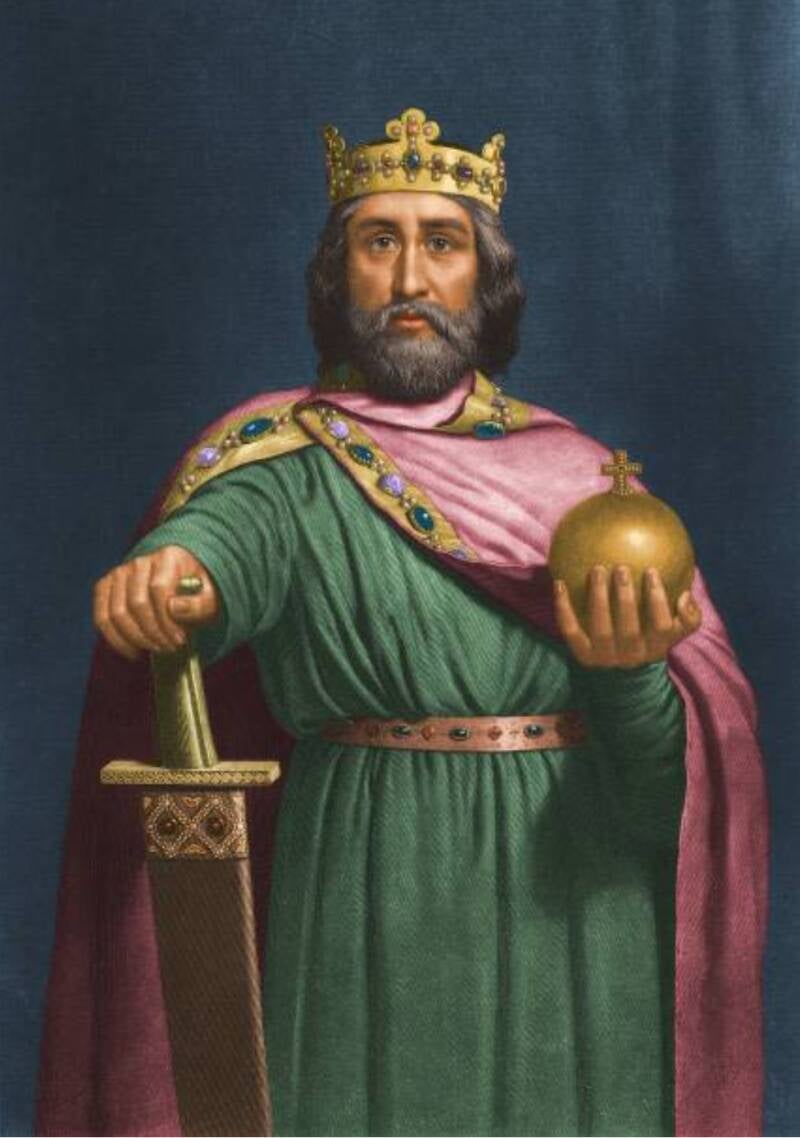
While Charlemagne did not found the House of Ventimiglia, it is highly likely that members of the family carried his DNA. Charlemagne had at least 18 children with multiple wives and concubines. By the high Middle Ages, his descendants had intermarried so extensively with local nobility across France, Germany, and Italy that practically every noble house claimed a "gateway ancestor" leading back to him to legitimize their right to rule.
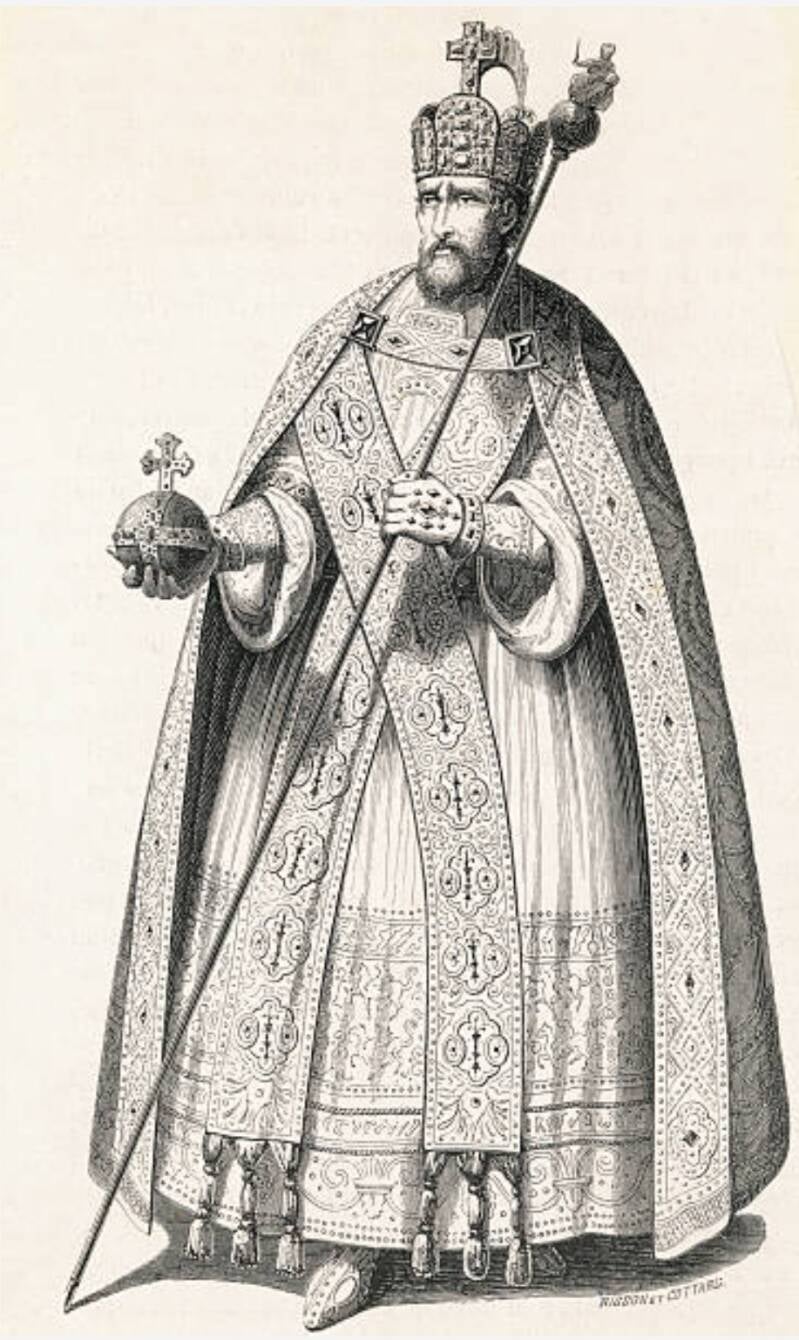
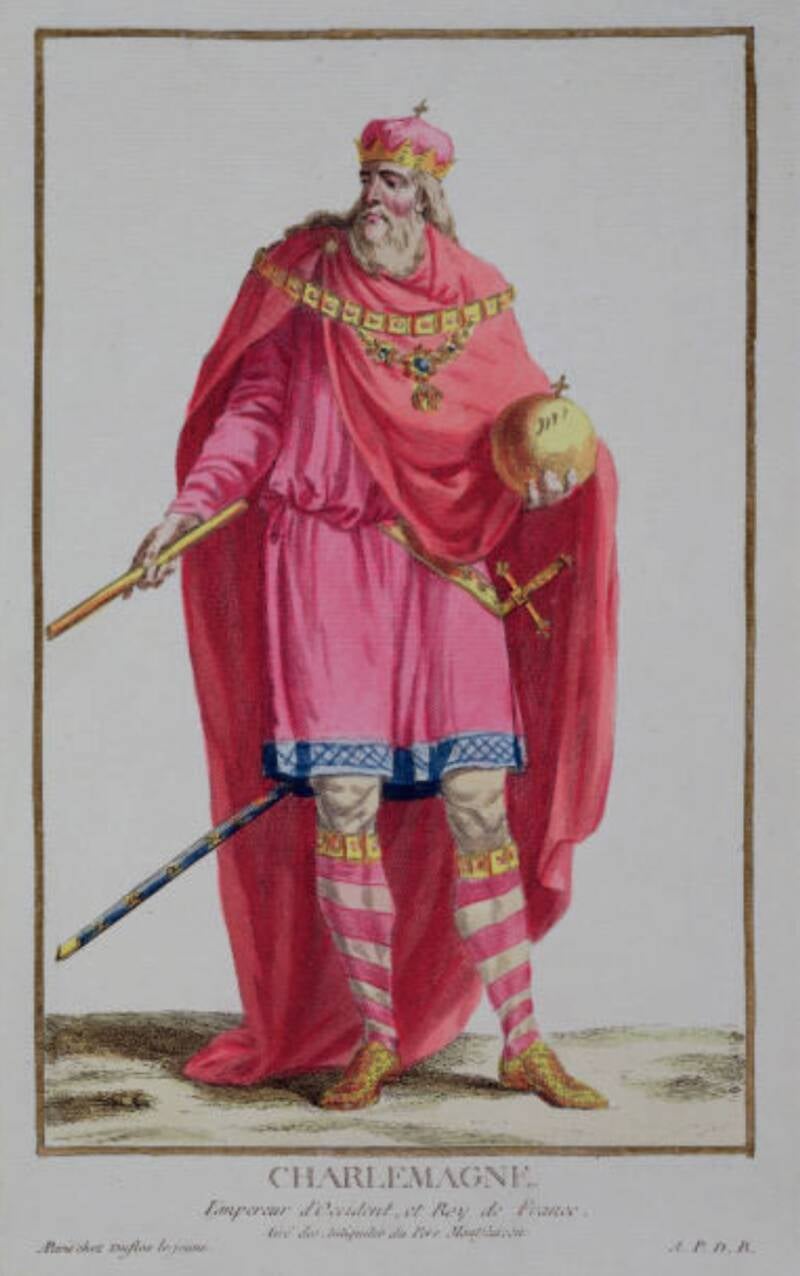
"The pictures all depict this gentleman Charlamaine featured with a sphereical object in his hand" "Interesting"
Never Say Never
The historical connection between Ventimiglia (a strategic border city in Liguria, Italy) and the Carolingian lineage exists through two distinct lenses: the Carolingian structural reorganization of northern Italy and the debated genealogical origins of the powerful Counts of Ventimiglia.
1. The Carolingian Geopolitical Framework
When Charlemagne conquered the Lombard Kingdom of Italy in 774, he overhauled the region's governance by replacing Lombard duchies with Carolingian counties (comitati).
- The Border Stronghold: Ventimiglia was chosen as a pivotal fortified county seat due to its position as the "Gateway to Italy," securing the vital coastal and Alpine passes between northern Italy and Frankish Provence.
- Defensive Infrastructure: Under Carolingian rule, the town expanded significantly. A defensive wall, an early fort, a cathedral, and the historic octagonal baptistery were constructed during this period to protect against maritime raids, particularly from Saracen pirates.
2. Genealogical Links of the Counts of Ventimiglia
The Ventimiglia family grew to become one of the most powerful and autonomous noble dynasties in medieval Liguria and, later, Sicily. Historians trace their early roots back to the wreckage of the Carolingian Empire through bloodline connections:
- The Konradiner/Ivrea Descent: Modern medieval historiography frequently traces the lineage of the early Counts of Ventimiglia back to Cono (Corrado) of Ivrea. Cono belonged to the prominent Konradiner dynasty, a noble house heavily intermarried with Charlemagne's direct descendants, the Carolingians. Cono's grandmother was Adelaide of Burgundy, linking the line directly into the highest echelons of post-Carolingian imperial royalty.
- Imperial Administrators: As the central power of the Carolingian kings fractured in the late 9th and 10th centuries, these imported Franco-Germanic noble administrators stabilized their own regional control. They successfully transformed their appointed Carolingian administrative offices into hereditary, semi-independent titles.
3. Later Dynastic Shifts
While the family established its local power under the shadow of the Carolingian system, its later expansion moved away from French influence and deeper into Mediterranean politics:
- The Lascaris Line: Through the 1261 marriage of Count Guglielmo Pietro I to Eudoxia Laskarina (daughter of the Byzantine Emperor Theodore II), a famous branch known as the Lascaris di Ventimiglia was born, wedding post-Carolingian Italian nobility with Byzantine imperial blood.
- The Sicilian Migration: In the 13th century, a prominent branch of the family migrated to Sicily under the Hohenstaufen and Aragonese crowns, becoming the immensely wealthy Counts of Geraci and dominating Sicilian feudal history for centuries.