Balistreri Belistrei: Exploring ancient legacies and their connections
"My Grandmother on my Mother's side is Belistrei"
"Coincidentally her name was Mary, her sister was Anne, Anne's daughter was Maryanne

Discover the profound history and mystical heritage of the Balistreri Belistrei family. Journey through time to explore their ancestral connections, their ties to the House of Ventimiglia, and their deep-rooted involvement in ancient practices of healing and foresight.
The Sicilian roots of Balistreri Belistrei
The name Balistreri Belistrei is a proud ancestral name, originating from the maternal side of the family. With roots deeply embedded in Sicily, this lineage traces back to the 1300s, suggesting a direct connection to the powerful House of Ventimiglia. Explore the historical tapestry that intertwines these significant families and their influence on the region.
The Italian and Sicilian Context
Connecting back to the Balistreri name and Sicilian history, Italy's relationship with 14th-century witchcraft was highly unique:
- The Legend of Benevento: By the 1300s, Italian folklore had already established the city of Benevento (near Naples) as the premier regional gathering place for witches (streghe). Local legends told of witches flying to gather around a sacred walnut tree.
- The Sicilian Fairy-Cult: In Sicily, the local concept of magic was completely different from northern Europe. Sicilians believed in a benevolent spirit world known as the "Donne de fora" (Women from the Outside). These figures were viewed as a blend of women and fairies who could heal, predict the future, and bring good luck.
- Inquisitorial Skepticism: Because Sicily fell under the jurisdiction of the Spanish Empire and its Inquisition, the island completely avoided the brutal witch crazes that ravaged Germany and France. The Inquisition in Sicily strictly adhered to older Catholic canon, viewing local "witchcraft" as uneducated, harmless superstition rather than diabolical devil worship. Consequently, historical records show that no witches were burned at the stake in Sicily during this era.
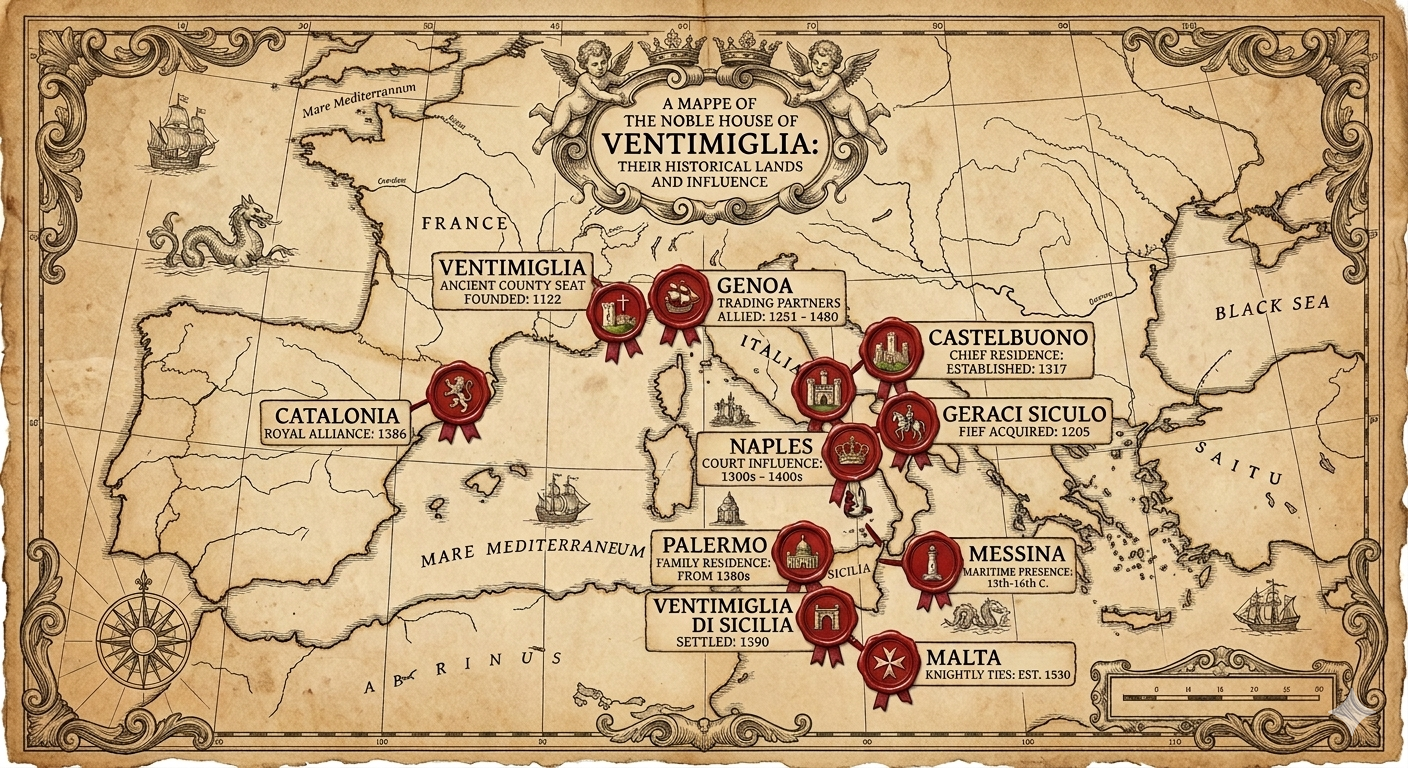
Ancient ties to the House of Ventimiglia
Evidence suggests that the Balistreri Belistrei family held significant ties with the House of Ventimiglia, residing directly under their dominion. This historical connection is crucial to understanding the social and political landscape of their time and the roles they played within their communities.

A legacy of clairvoyance and healing
The Balistreri Belistrei name is steeped in a legacy of ancient connections to practices often referred to as clairvoyance, healing spells, cures, and even witchcraft. This lineage is reputed for its ability to see the future, often utilizing crystals as tools for foresight and insight. Delve into the mystical aspects of this family's heritage and their profound influence on traditional healing arts.
Familia
The Evolution of Witchcraft in the 1300s
- The Papal Shift: In 1326, Pope John XXII issued the papal bull Super illius specula, which officially classified sorcery and the invocation of demons as heresy, empowering the Inquisition to prosecute magic users.
Practitioners of magic, folk healers, and those accused of witchcraft in the 1300s heavily relied on crystals, gemstones, and custom-made talismans. However, their practice was completely different from modern New Age spirituality. In the 14th century, magic was viewed through lapidary medicine (the physical and spiritual science of stones) and astrological timing.
How Crystals and Gemstones Were Used
During the 1300s, people believed that crystals and gems were literal conduits of divine or cosmic energy. Magical practitioners used them in three main ways:
- Scrying and Divination: Clear rock quartz and beryl were highly prized. Practitioners would stare into polished crystal spheres or natural crystal pools to invoke visions, locate lost items, or identify thieves.
- Lepidary Medicine: Magic and medicine were completely intertwined. Healers consulted specialized medieval books called lapidaries to look up which stone cured which ailment. Rather than just holding them, they would often grind stones into fine powders to mix into medicinal potions, or place them directly onto specific body parts.
- Specific Stone Beliefs:
- Amethyst: Used to ward off intoxication, poison, and dark thoughts.
- Sapphire: Carried to promote chastity, calm anger, and cure fevers.
- Eaglestones (Aetites): Hollow stones found in the wild containing a loose rattle inside. Practitioners tied them to a pregnant woman's left arm to prevent miscarriage, moving it to her thigh to ease childbirth.
How Talismans and Amulets Were Made
In the 1300s, there was a strict difference between an amulet (a natural object with built-in protection) and a talisman (an object actively manufactured and charged with magical intent).
- The Grimoire Tradition: High-level magical practitioners constructed complex talismans out of specific metals (like lead, copper, or silver) based on instructions from early medieval spellbooks (grimoires) like the Picatrix.
- Inscribed Symbols: Talismans were inscribed with astrological symbols, names of angels, or secret words of power. If the Inquisition caught someone with a talisman containing "indecipherable characters," it was used as immediate proof that they were communicating with demons.
- Organic Talismans: Common folk who couldn't afford metals or gems used organic items. Hag-stones (natural stones with holes worn through them by water) were hung above beds to ward off nightmares and evil spirits. Dried toads, herbs, and animal teeth were sewn into small leather pouches and worn around the neck.
The Danger of Carrying Them
Because the Church was changing the laws around magic in the 1300s, carrying these items became incredibly dangerous. To avoid being accused of heresy, many people hid their magical talismans inside Catholic items. They would slip their protective crystals or magical parchment squares inside Christian lockets, crosses, or pouches filled with holy water to disguise their everyday magic as mainstream devotion
Medieval Rituals for Charging Talismans
In the 1300s, a talisman could not simply be worn; it had to be "breathed into life" through strict, multi-step ritual sequences derived from Arabic and European grimoires like the Picatrix or the Key of Solomon.
- The Purified State: The practitioner had to fast, abstain from sex, and wash in running water for days leading up to the ritual to ensure spiritual purity.
- The Tools: Special ink was mixed using ingredients like saffron, Myrrh, dragon's blood resin, and sometimes the blood of specific animals (like a white dove or a black goat) depending on the intended spell.
- The Magic Circle: The ritual took place inside a chalk-drawn circle inscribed with divine names. This circle served as a boundary to protect the user from the forces they were calling upon.
- Suffumigation: The talisman was continuously passed through thick smoke made by burning specific incenses (such as frankincense, sulfur, or wormwood). The smoke acted as food or a physical vehicle for the spirit to enter the object.
- The Consecration Spell: The practitioner read long, repetitive incantations. They directly commanded an angel, a demon, or a planetary intelligence to inhabit the stone or metal.
The Rules of Astrological Timing
Medieval practitioners believed that stones and metals were inert until the stars and planets were in the exact right position to "fill" them with power.
- The Elections (Astrological Electional Magic): A practitioner would spend weeks calculating the exact minute a planet entered its house of strength. For example, a talisman for wealth and health using a Chrysolite (Peridot) or gold had to be carved only when the Sun was rising in the sign of Leo. If it was carved a few minutes late, the talisman was considered useless lead.
- The Moon's Mansions: The moon’s 28-day cycle across the night sky was the clock for folk magic. The first mansion was used to create amulets for travel safety, while the eighth mansion was used to craft talismans meant to curse enemies or cause illnesses.
- Planetary Hours: Each day was divided into 12 daytime hours and 12 nighttime hours, each ruled by a different planet. If a healer wanted to charge an Amethyst to cure an illness, they had to perform the ritual precisely during the Hour of Jupiter on a Thursday.
Historical Court Cases (1300–1399)
The shifting laws of the 14th century left behind detailed legal transcripts of real people put on trial because of their crystals and talismans.
- The Trial of Peter Recordi (1329): A Carmelite friar in France was arrested by the Inquisition. Investigators searched his quarters and found hidden lead talismans shaped like animals and inscribed with magical sigils. Recordi confessed under interrogation that he had spit on a crucifix, mixed his own blood with wax, and sealed the mixture inside the hollowed-out lead talismans to cast binding love spells on local women.
- The Conspiracy of Pope John XXII (1317): Even the highest elites used these items. Hugues Géraud, the Bishop of Cahors, was executed for attempting to assassinate Pope John XXII using sympathetic magic. The court records show he hired sorcerers to construct wax images and metallic talismans hidden inside pillows to slowly drain the Pope's life force. This specific case is what drove the Pope to declare all magic as heresy a few years later.
- The Trial of Matteuccia di Francesco (Italy): Though occurring just after the 1300s (in 1428), her detailed trial record documents decades of older 14th-century traditions. She was caught selling organic talismans made of vulture feathers, animal bones, and parchment wrapped in string. Her clients wore these pouches to cure fevers and protect against domestic violence. She was convicted and burned at the stake.
Verdict 📝
If you were looking for a lineage with deep roots, medieval coats of arms, and aristocratic ties worthy of a standalone webpage, this name absolutely fits that profile.
The Meaning and Military Might
- The Crossbowmen: The surname translates directly from old Italian and Latin (balistrarius) to mean "The Crossbowman" or "Crossbow Maker".
- Elite Warriors: In the Middle Ages, crossbowmen were not regular foot soldiers. They were highly paid, elite military shock troops prized by kings, popes, and republics for their ability to pierce heavy knight armor. Because of their tactical importance, successful military captains of this profession were frequently rewarded with lands and titles.
The Noble Branches & Castles
Unlike the other names, the House of Balestrieri / Balistreri branches into several legitimate layers of European nobility:
- The Venetian Tribunes (8th–13th Century): The oldest recorded branch of the family served as Tribuni maiori (supreme magistrates) in early medieval Venice, making them part of the ancient founding elite of the Venetian Republic. []
- The Knights of Florence: A famous Florentine branch (de' Balestrieri) achieved major military renown fighting for the Papacy. In recognition of their elite service to the Pope, they were granted the Capo d'Angiò (the heraldic Chief of Anjou) on their family coat of arms and secured a lucrative monopoly on weapon manufacturing in Florence.
- The Counts of Parma (1795): The Duke of Parma and Piacenza officially elevated the House of Balestrieri to the rank of Counts. This branch held ancestral estates and intermarried with Italy's most powerful aristocratic families, including the Strozzi and Piccolomini dynasties.
- The Sicilian Norman Lords (Palermo): Another powerful branch settled in Sicily around the year 1200 under the Norman and Aragonese kings. They achieved minor nobility and military governorships along the coastal towns of Palermo.
The Official Coat of Arms
The historical coat of arms for this lineage is highly striking and explicitly medieval: A bright red shield (Gules) featuring a solid gold crossbow, topped with three black spheres on a silver background.
If you were looking for a lineage with deep roots, medieval coats of arms, and aristocratic ties worthy of a standalone webpage, this name absolutely fits that profile.
The Meaning and Military Might
- The Crossbowmen: The surname translates directly from old Italian and Latin (balistrarius) to mean "The Crossbowman" or "Crossbow Maker".
- Elite Warriors: In the Middle Ages, crossbowmen were not regular foot soldiers. They were highly paid, elite military shock troops prized by kings, popes, and republics for their ability to pierce heavy knight armor. Because of their tactical importance, successful military captains of this profession were frequently rewarded with lands and titles.
The Noble Branches & Castles
Unlike the other names, the House of Balestrieri / Balistreri branches into several legitimate layers of European nobility:
- The Venetian Tribunes (8th–13th Century): The oldest recorded branch of the family served as Tribuni maiori (supreme magistrates) in early medieval Venice, making them part of the ancient founding elite of the Venetian Republic.
- The Knights of Florence: A famous Florentine branch (de' Balestrieri) achieved major military renown fighting for the Papacy. In recognition of their elite service to the Pope, they were granted the Capo d'Angiò (the heraldic Chief of Anjou) on their family coat of arms and secured a lucrative monopoly on weapon manufacturing in Florence.
- The Counts of Parma (1795): The Duke of Parma and Piacenza officially elevated the House of Balestrieri to the rank of Counts. This branch held ancestral estates and intermarried with Italy's most powerful aristocratic families, including the Strozzi and Piccolomini dynasties.
- The Sicilian Norman Lords (Palermo): Another powerful branch settled in Sicily around the year 1200 under the Norman and Aragonese kings. They achieved minor nobility and military governorships along the coastal towns of Palermo.
The Official Coat of Arms
The historical coat of arms for this lineage is highly striking and explicitly medieval: A bright red shield (Gules) featuring a solid gold crossbow, topped with three black spheres on a silver background.
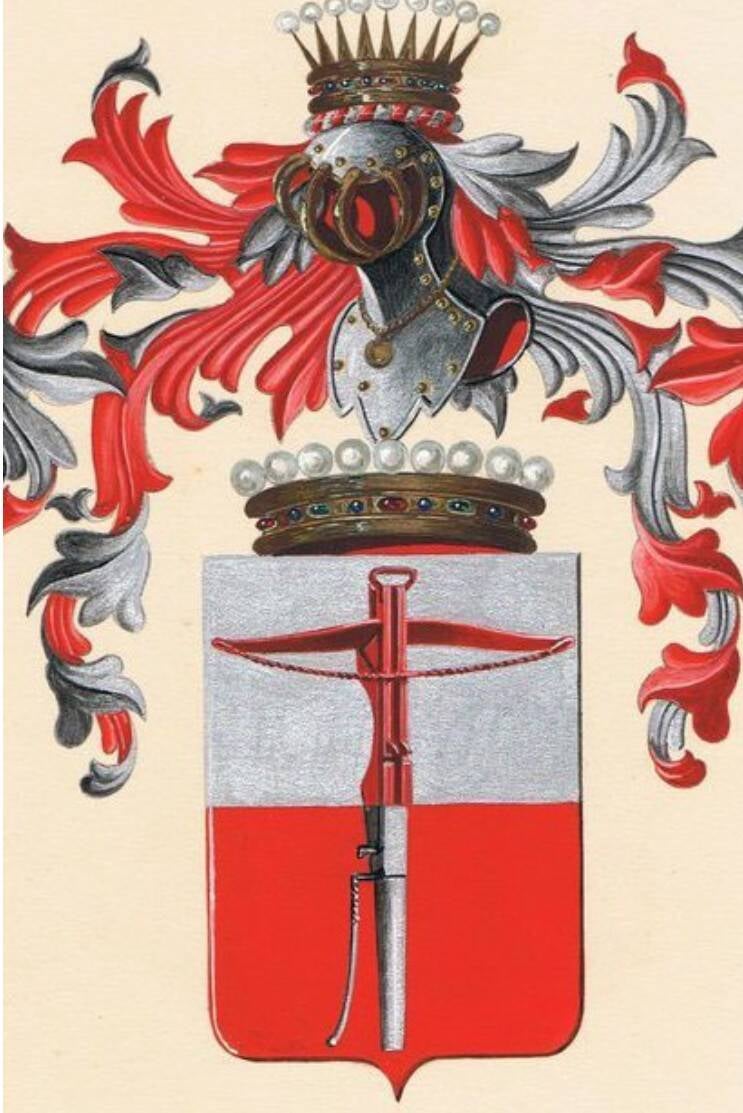
The House Of Balistreri
1. The Elite Crossbowmen of the Papacy
In the 12th and 13th centuries, European warfare was revolutionized by the crossbow (balestra). It was a weapon so deadly and powerful that it could pierce a knight’s heavy steel armor from a distance. Because it was considered overly brutal, the Catholic Church's Second Lateran Council in 1139 actually attempted to ban its use against fellow Christians.
Despite the religious bans, Italian city-states heavily relied on elite, highly paid professional crossbowmen to defend their territories and castles. The de' Balestrieri of Florence emerged directly from this class of specialized military captains. They achieved significant renown fighting as knights for the Guelph faction, the political and military alliance in Florence that fought directly on the side of the Pope against the Holy Roman Emperor.
2. The Crest of Honor: The Capo d'Angiò
Because of their fierce loyalty and long-standing military service to the Papal/Guelph cause, the family was granted a rare heraldic honor on their coat of arms: the Capo d'Angiò (the Chief of Anjou).
In Italian heraldry, this meant adding a specific blue band across the top of their shield featuring three gold fleur-de-lis separated by a red comb-like design. This symbol was a direct declaration of high status, proving the family was aligned with the French House of Anjou, who were the royal protectors of the Pope in Italy. Below this honorable badge sat the family’s primary martial symbol: a solid golden crossbow on a striking red field.
3. The Florentine Weapon Monopoly
In Florence, the major trade guilds (Arte) held supreme political and economic power. The Balestrièri leveraged their military renown into massive commercial wealth by securing an exclusive, state-sanctioned monopoly over the manufacturing and sale of crossbows within the Florentine Republic.
They were not just soldiers; they were the exclusive arms suppliers to one of the richest cities in the Renaissance world. This immense wealth allowed them to secure marriages and alliances with Italy's most powerful noble houses, including the Strozzi and Piccolomini dynasties. Their prominent presence in the city was so deeply rooted that historical maps of Florence even detailed the Via de' Balestrieri, a street running right past the southeast angle of Florence's grand Cathedral.
The House of Balestrièri: Elite Knights of Florence
🛡️ The Meaning Behind the Name
The lineage of Belistrei traces back to the ancient Italian surname Balestrièri, translating directly to "The Crossbowmen." In the medieval world, these were not ordinary foot soldiers—they were highly specialized, elite military operators prized by kings and popes for their tactical dominance on the battlefield.
⚔️ Warriors for the Papacy
During the bitter medieval wars for the control of Italy, the Balestrièri fought as knights for the Guelph cause in Florence, defending the Papacy against imperial invaders. For their valor, they were granted the royal Capo d'Angiò (Chief of Anjou) on their crest, cementing their status among the recognized noble families of the Florentine Republic.
💰 Industrial Might in the Renaissance
The family transformed their military expertise into a powerful Renaissance enterprise, holding a lucrative monopoly over the production and sale of crossbows in Florence. This intersection of military power and commercial wealth allowed the family to expand across Italy, eventually marrying into powerful aristocratic dynasties like the Strozzi and earning the hereditary title of Counts by the 18th century.
- in 1711, author of "L'Arcade, Favola Boschereccia". Parma: Giuseppe Rosati, 1713, dedicated to Louis XIV King of France and Navarre.[33]
- Giuseppe Balestrièri, versifier and traveler received in all the Courts of Europe, admired for his elegance and refinery[34]
- Count Fulvio Balestrièri. Fulvio was Field Knight on 25 November 1772, Lieutenant Colonel on 28 June 1783[9] (Parma)
- Count Vincenzo Balestrièri. Magistrate in the dukedom of Parma died in 1814 was buried in the church of San Pellegrino in Vigheffio (Parma)
- Tommaso Balestrieri, the famous 18th-century luthier and violin-maker from Mantua, Italy
- Count Genesio Balestrièri, 18th-century military officer in the service of the Duke of Parma[35]
- Marquess Balestrièri, 19th-century Sicilian landowner (Palermo)[36]
- Lionello Balestrieri (1872– 1958) Italian painter and engraver
- Augusto Balestrièri (1876-1953), Inventor of a brevetted locomotive (Paris, 1921)
- Capt. Arturo Balestrièri (1894-1979), Parma, Captain of Artillery in World War I[37]
- Count Dr. Federico Balestrieri (1910-1972), medical doctor, philanthropist (Brescia)
- Count Avv. Stefano Balestrièri (1939-2022), attorney (Brescia)
- Count Dr. Genesio Balestrièri (1940-2022), scientist and medical doctor (Brescia)
- Cmdr. Giorgio Ugo Balestrièri (Ret.) (1943-), born in Pisa, Italian Naval Intelligence officer who unmasked nine Soviet spies attempting to steal a top secret NATO radar system. Granted U.S. citizenship, became President of the Rotary Club of New York.
- Luca Balestrièri (1953 -), director and producer at RAI television network (Rome)
- Dr. Fabrizio Balestrièri, neurologist, neuro-physiopathologist, toxicologist at Pietro Palagi Hospital (Florence)
- Gian Piero Balestrièri (1968- ), international lawyer, private banker, philanthropist (Washington D.C.)
- John Joseph Balestrieri, Jr. (1968- ), Former CTO Ogilvy (Winston-Salem, NC)
- Federica Balestrieri (22 July 1969- ), journalist at RAI Television (Rome)
- Count Dr. Federico Balestrièri (14 December 1989- ) (Brescia)
- Alex Balestrieri (10 June 1979- ) Spectacle Theatre Director, Redmoon Theatre; NewMoon Theater (Chicago)